In short: Tenerife is the largest and most populous of the Canary Islands and offers two very different lives: the green, Spanish-flavoured north with cheaper rents and the sunny, touristy south. If you bring a location-independent job, a pension or a business with island clients, you can live very well here. If you are counting on a local job, expect low wages and scarce housing.
At a glance
- Population: around 962,000 (sum of INE municipal figures, as of 1 January 2025)
- Rent: from 10.4 €/m² in Icod de los Vinos to 19.0 €/m² in Adeje (Idealista, September 2026)
- Climate: on the coast around 21 °C in January and 29 °C in August (AEMET, Santa Cruz)
- Tax: IGIC instead of VAT, general rate 7 %
- Job market: unemployment rate in the Canary Islands 11.6 % (EPA, Q2 2026)
- Who it’s for: remote workers, retirees, families with a budget for a private school, self-employed people with island clients
Who is Tenerife right for, and who not?
Tenerife is not a holiday island where you just happen to live. It is an island with almost a million inhabitants, a big city, a university, motorways and traffic jams. That makes everyday life easier than on small islands, but also less idyllic than holiday photos suggest.
Tenerife is a good fit if you:
- bring your income with you (remote job, pension, clients in Germany or Austria)
- want a mild climate all year round without hot summers
- are looking for a city with infrastructure, not just a beach resort
- are willing to learn Spanish, especially if you move to the north
- are looking for nature: Teide, the Anaga mountains, hiking trails right on your doorstep
The island is less suitable if you want to pay for a flat in the south on an average Spanish salary, need to commute cheaply to Germany on a regular basis or order a lot online. Parcels from the mainland are more expensive and slower (more on this below). And if you miss the seasons and autumn forests, you will rarely be happy in the long run.
German-speaking doctors in Tenerife: 13 verified practices and clinics →
North or south: the best areas to live
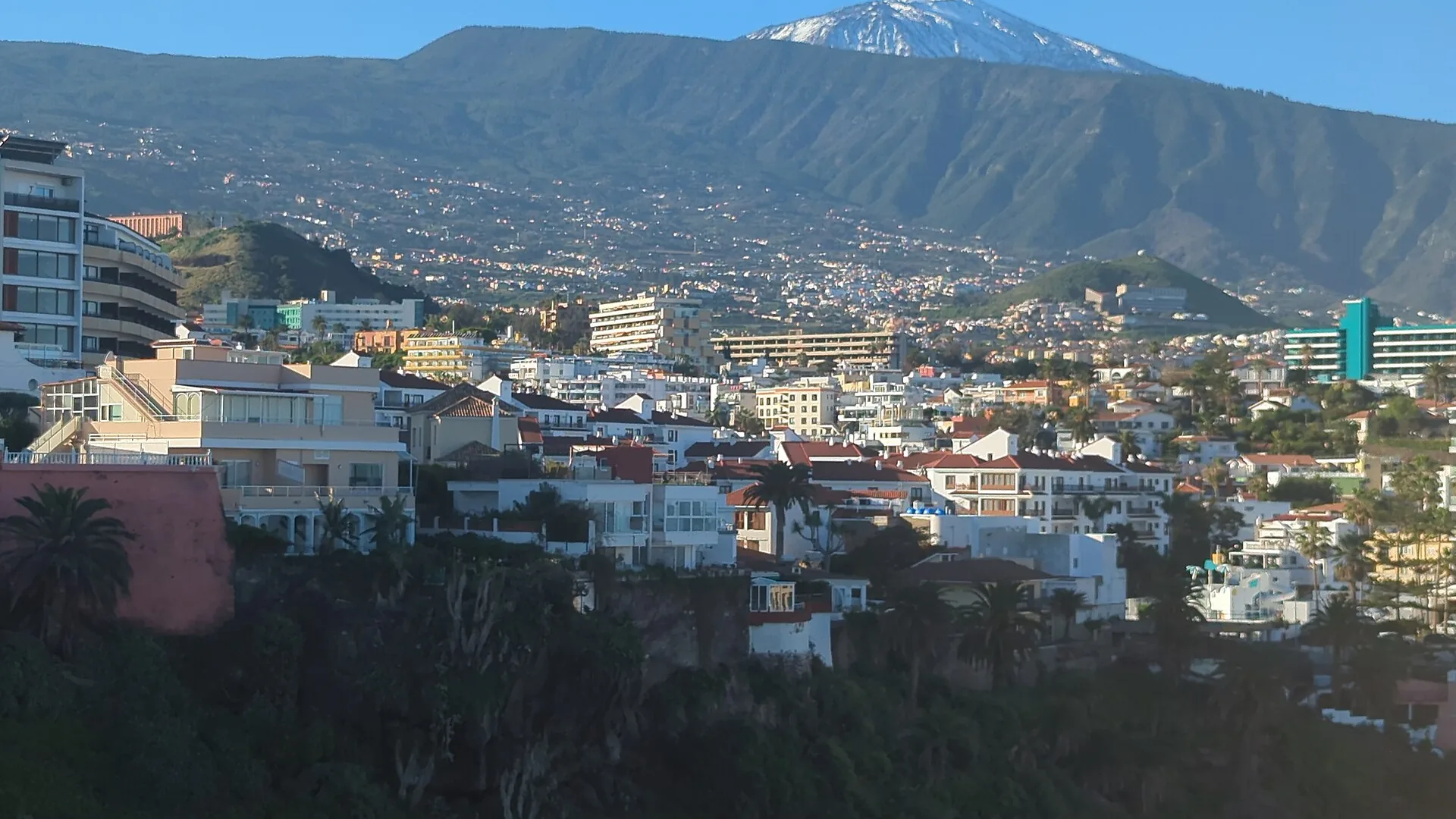
The Teide massif divides the island. The trade wind piles up clouds in the north, where it is greener and more often overcast. The south lies in the lee of the wind and is sunny and dry. You’ll find the comparison from a holidaymaker’s point of view under Tenerife north or south. For living there, price, language and commute also come into play.
Santa Cruz de Tenerife
The capital (around 212,000 inhabitants) is the administrative centre: authorities, hospitals, shops, port. It is sunnier than the north coast because the Anaga mountains shelter it. At 14.0 €/m², rents are mid-range. Good for anyone who wants city life, short distances to public offices and a Spanish everyday life.
La Laguna
San Cristóbal de La Laguna (around 161,000 inhabitants) borders directly on Santa Cruz and is connected to it by tram. The old town is a UNESCO World Heritage Site, and the university is here (see Studying in La Laguna). It is cooler and damper than on the coast. At 12.7 €/m², La Laguna is one of the cheaper places with city infrastructure.
Puerto de la Cruz and La Orotava
Puerto de la Cruz has been popular with German-speaking long-stay guests for decades: old town, promenade, seawater pools, many older residents. At 16.5 €/m², rent is high for the north, because many flats go to holidaymakers. The neighbouring small town of La Orotava sits on the slope above the valley, with manor houses and wooden balconies, and at 11.4 €/m² it is one of the cheapest places for which Idealista publishes figures. Los Realejos (12.0 €/m²) and Santa Úrsula (12.1 €/m²) are also options for families with a car.
Costa Adeje and Los Cristianos
In the south are Adeje (19.0 €/m²) and Arona (18.9 €/m²), which includes Los Cristianos. This is where the sun is most reliable, the infrastructure is geared towards holidaymakers, and you often hear English and German. Costa Adeje is the upmarket part; Los Cristianos has grown more organically, with a port and ferries to La Gomera. Downside: the highest rents on the island and fierce competition with holiday rentals.
El Médano
El Médano belongs to the municipality of Granadilla de Abona (15.8 €/m²). The town is windy, relaxed and popular with kitesurfers, windsurfers and younger remote workers. Tenerife South Airport is close by, which is practical but can also mean aircraft noise. The holiday vibe is real; the supply of long-term flats is small.
What does living on Tenerife cost?
The biggest item is rent. The following figures are asking rents from the Idealista report for the province of Santa Cruz de Tenerife, as of September 2026. The column for 70 m² is a simple extrapolation; small flats usually cost more per m².
| Town | Rent €/m² | 70 m² (calculated) | Change on previous year |
|---|---|---|---|
| La Orotava | 11.4 | around 800 € | +5.4 % |
| La Laguna | 12.7 | around 890 € | +7.4 % |
| Santa Cruz | 14.0 | around 980 € | +5.8 % |
| Granadilla (El Médano) | 15.8 | around 1,110 € | +4.7 % |
| Puerto de la Cruz | 16.5 | around 1,160 € | minus 2.7 % |
| Arona (Los Cristianos) | 18.9 | around 1,320 € | minus 0.1 % |
| Adeje | 19.0 | around 1,330 € | minus 2.7 % |
According to Idealista, a room in a shared flat in Santa Cruz cost an average of 420 € a month in the first quarter of 2026. The other items are hard to document. The following table is therefore our own estimated range for one person, not a statistic.
| Item | per month (estimate) | Note |
|---|---|---|
| Electricity | 40 to 90 € | hardly any heating, possibly air conditioning in the south |
| Water, butane gas | 20 to 40 € | no mains gas network, hot water often via gas bottle or electricity |
| Internet and mobile | 35 to 60 € | fibre widespread in towns |
| Groceries | 250 to 380 € | imported goods more expensive, local fruit and vegetables cheap |
| Car (fuel, insurance, maintenance) | 120 to 250 € | fuel cheaper than on the mainland |
| Private health insurance | 60 to 200 € | depends heavily on age and plan |
For comparison: according to INE, a household in the Canary Islands spent an average of 12,652 € per person in 2025, a good 1,050 € a month. For owners, this figure includes an imputed rent and is only a rough guide. You can work out the costs for Spain as a whole with the calculator under Cost of living in Spain.
Canary Islands specifics: IGIC, parcels and resident discount
The Canary Islands have a special tax status that you come across constantly in everyday life:
- IGIC instead of VAT: the general rate is 7 % instead of 21 % on the mainland (as of October 2026). This makes many things a little cheaper.
- Parcels from Germany: the Canary Islands are not part of the EU VAT area. Shipments from the mainland or from Germany count as imports. IGIC and a handling fee from the parcel service are often charged, delivery takes longer, and some online shops don’t deliver to the islands at all.
- Resident discount: if you are registered in the Canary Islands, you get a 75 % discount on flights and ferries within Spain, that is, between the islands and to the mainland. The discount does not apply to direct flights to Germany or Austria.
Work and self-employment: a realistic view
The job market is where many relocation plans fail. The unemployment rate in the Canary Islands was 11.6 % in the second quarter of 2026, above the Spanish figure of 9.87 % (INE, EPA). According to INE, the average gross annual salary in the Canary Islands was 25,120 € in 2024; in hospitality, where most jobs are created, the Spanish average is around 17,650 €.
Without Spanish, what’s left are mainly jobs in tourism: hotels, holiday complexes, estate agencies, customer service for German-speaking guests, mostly in the south. That is a way in, but rarely a basis for a family. You’ll find more on the options under Working in Spain.
Remote workers and the self-employed are better off. As an Autónomo (self-employed person) you register just as on the mainland, see Registering as an Autónomo. The Canary Islands offer two advantages: you issue invoices with 7 % IGIC instead of 21 % VAT, and for turnover up to 50,000 € you can use the REPEP small business scheme. On top of that there is the Canarian “Cuota cero”, which retroactively refunds the reduced social security contributions to new self-employed people. All the details are under Self-employed in the Canary Islands.
Moving to Tenerife as a retiree
For retirees, Tenerife is one of the most popular places in Spain. The climate is mild all year round, the summer heat is moderate, and there have been many German-speaking residents for decades, especially in Puerto de la Cruz and in the south around Los Cristianos and Costa Adeje.
Three points matter. First, health insurance: with the S1 form from your German or Austrian health insurance fund, you are admitted to the Spanish public system (see below). Second, taxes: if you live in Spain for more than 183 days a year, you are tax resident here, and your state pension is then generally taxed in Spain. Third, getting older: if you can’t drive, you will live better in Santa Cruz, La Laguna or Puerto de la Cruz than in an urbanización on a hillside. More on this in the article Moving to Spain as a retiree.
Moving to Tenerife with children: schools and nursery
In Spain, school is compulsory for children from 6 to 16. Public schools are free, and lessons are in Spanish. Younger children in particular usually learn the language quickly; for teenagers the start is harder.
Registration for Infantil (pre-school) and Primaria (primary school) takes place in spring in the Canary Islands: for the 2026/27 school year, the application period ran from 6 to 17 April 2026 and enrolment from 17 to 26 June. If you move during the school year, you get a place through a separate procedure, but not necessarily at the school of your choice. In practice, the prerequisite is the Padrón (registration at the town hall).
The Deutsche Schule Teneriffa (German School Tenerife) is in Tabaiba Alta, between Santa Cruz and Candelaria. It leads to the Abitur (German university entrance qualification) and the Spanish Bachillerato and accepts children from the age of one. According to the school’s website, in 2026/27 grades 1 to 8 cost 425 € a month (ten instalments), kindergarten 465 € and the crèche 410 € a month, plus an enrolment fee and a deposit. If you live in the south, you have a long way to school. You’ll find more on nursery, paediatricians and choosing a school under Moving with your family.
Health and health insurance
The public health system in the Canary Islands is the Servicio Canario de la Salud (SCS). You get access in two steps: the Spanish social security (INSS) recognises your entitlement, then the SCS issues the health card and assigns you a Centro de Salud (health centre).
- Employees and the self-employed are insured through their registration with social security.
- Retirees apply for the S1 form from their health insurance fund before the move and present it in Spain.
- If you neither work nor receive a pension, you first need private health insurance. After one year of residence and with Padrón, you can join the public system in the Canary Islands via the Convenio especial. According to the Ministry of Health it costs 60 € a month under 65 and 157 € from 65, and you then pay for medicines yourself.
There are large hospitals in Santa Cruz and La Laguna; in the south there is a hospital and health centres in the holiday resorts. The process is described step by step in Health insurance in Spain.
Climate through the year
The climate is the main reason people move to Tenerife. According to AEMET, the average daily maximum in Santa Cruz is 21.0 °C in January and 29.0 °C in August, and at night in winter it drops to around 15 °C (normal period 1981 to 2010). Santa Cruz has around 2,900 hours of sunshine a year, and rain falls almost only from October to March.
More important than the season is the location. In the north, trade wind clouds often hang low; in La Laguna it is damp and noticeably cooler in winter, and flats without heating then feel clammy. In the south the sun almost always shines, but it is drier and windier. From about 1,000 metres altitude you need heating in winter. A few days a year, calima (Saharan dust) brings hazy air and heat. More under Canary Islands weather.
Getting around: car, bus and flights
Without a car, Tenerife is only convenient in Santa Cruz, La Laguna and Puerto de la Cruz. The TF-5 (north) and TF-1 (south) motorways meet near Santa Cruz, and traffic jams at rush hour are part of everyday life. So plan your commute before you start looking for a flat.
- Bus and tram: the TITSA buses (guaguas) connect the whole island, and the tram runs between Santa Cruz and La Laguna. For frequent travellers resident in the Canary Islands, bus and tram are free in 2026; the conditions are set by the operator.
- Car: re-registering a car registered in Germany is more complicated in the Canary Islands, because it has to be declared to customs as an import. When you move, it is exempt from IGIC under certain conditions. Many people buy locally anyway. Details under Re-registering your car and driving licence.
- Flights: Tenerife South handles most direct flights to Germany and Austria; Tenerife North near La Laguna mainly handles inter-island flights and connections to the mainland. The Canary Islands are one hour behind German time.
Authorities and first steps on arrival
The order of the first few weeks on Tenerife is the same as in the rest of Spain. The bottleneck is appointments, especially in Santa Cruz and in the south.
-
Apply for your NIE
You need the tax identification number for foreigners for your rental contract, bank, work and car. How it works is explained under Applying for the NIE.
-
Flat and Padrón
With your rental contract, you register at the town hall of your municipality. The Padrón is the prerequisite for your health card, school and the resident discount. See Registering for the Padrón.
-
Open a bank account
You need a Spanish account for rent, electricity and Bizum, see Bank account in Spain.
-
Sort out health insurance
Social security, S1 or private, then the health card at the SCS.
-
Deregister in Germany or Austria
Only once your residence in Spain is in place, see Abmeldung (deregistration).
You’ll find the complete order for the whole of Spain in the moving checklist.
Experiences and typical mistakes
If you listen around in forums and groups, you keep reading the same stories. Most problems can be avoided.
- Deciding based on your holiday spot: your favourite holiday spot is often the most expensive and most touristy. Live there on a trial basis for a few weeks outside the season first, ideally in both the north and the south.
- Counting on a local job: wages are low and rents in the south are high. Plan with savings for at least six months.
- Renting a flat from a distance: advance payments without a viewing are a common scam. Tips on this under Finding a flat.
- Underestimating the language: in the south you can get by with German and English, but not with the authorities, doctors or at school.
- Underestimating island life: after a year, many people realise they miss the mainland, train journeys or the seasons. Plan regular trips.
Help with moving to Tenerife
deinSpanien advises you online in English or German for all of Andalusia and the Canary Islands, including Tenerife. We take care of appointments, forms and powers of attorney for the NIE, Padrón, social security and so on, so you either go fully prepared or we complete the steps for you. We are on the ground in Spain ourselves and know all the steps from our own experience. What we offer is listed under Advice.
Frequently asked questions
Is it worth moving to Tenerife?
Yes, if you bring your income with you and like island life. The climate, nature and infrastructure are very good. If you depend on a local job, do the maths carefully beforehand, because wages are low and rents have risen.
Where is the cheapest place to live on Tenerife?
In the north. According to Idealista, in September 2026 rents were 10.4 €/m² in Icod de los Vinos, 11.4 €/m² in La Orotava, 12.0 €/m² in Los Realejos and 12.7 €/m² in La Laguna. In the south, in Adeje and Arona, you pay around 19 €/m².
How much money do I need to live on Tenerife?
That depends mainly on the rent. For one person in a small flat in the north, we estimate 1,400 to 1,800 € a month is realistic, and much more in the south. Plan for your own buffer for the deposit, furniture and the first few months.
Can I find work on Tenerife without Spanish?
In tourism in the south there are jobs for German speakers, for example in hotels, estate agencies or customer service. They are usually poorly paid. In the long run you need Spanish.
Is there a German school on Tenerife?
Yes, the Deutsche Schule Teneriffa in Tabaiba Alta, between Santa Cruz and Candelaria. It goes up to the Abitur and accepts children from the age of one. It charges fees.
Am I covered by health insurance on Tenerife as a retiree?
If you receive a German or Austrian state pension and are insured there, you apply for the S1 form and are then covered by the Spanish public system. Without S1 you need private insurance.
What is different on Tenerife compared with mainland Spain?
Instead of VAT there is IGIC at 7 %, parcels from Germany go through customs, there is a 75 % resident discount on flights and ferries within Spain, and the clocks are one hour behind.
Sources
- Idealista: rental price report for the province of Santa Cruz de Tenerife
- INE: population by municipality, province of Santa Cruz de Tenerife
- INE: Labour Force Survey (EPA), Q2 2026
- AEMET: climate data Santa Cruz de Tenerife
- Deutsche Schule Teneriffa: registration and fees
- Ministry of Health: Convenio especial
As of: October 2026
Free
The moving checklist as a PDF (in German)
All steps in the right order to tick off. Plus the key tips by email over the next weeks (in German). Free, unsubscribe at any time.