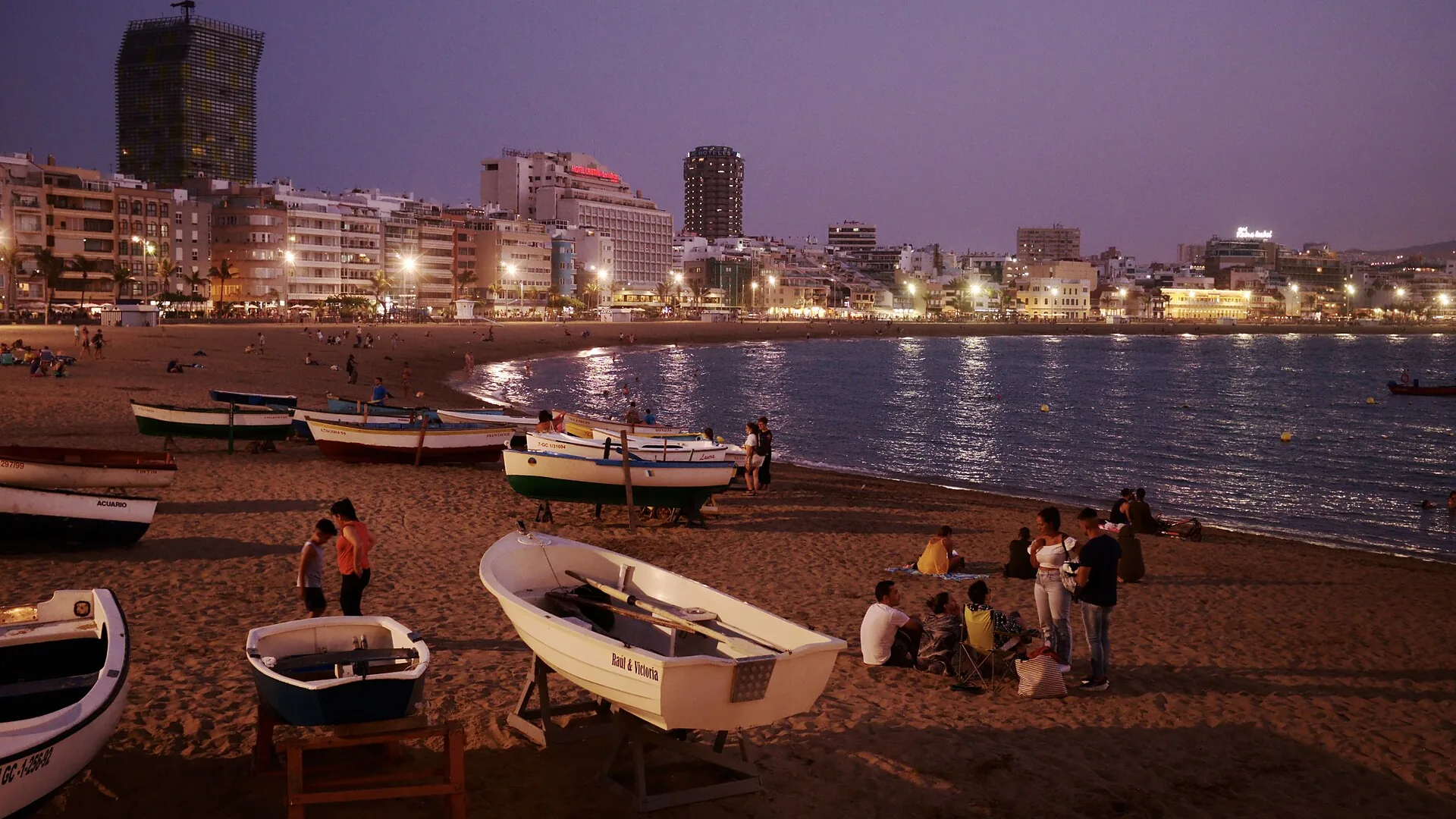
In short: Erasmus in Las Palmas de Gran Canaria means: a big city with a city beach, lectures in Spanish and a semester that starts as early as the beginning of September. The host university, the ULPGC, handles everything through its Mi Movilidad portal, offers a free Spanish course worth 6 ECTS and requires private health insurance in addition to the EHIC. The grant roughly covers your room here; the rest comes out of your own pocket.
At a glance
- Host university: Universidad de Las Palmas de Gran Canaria (ULPGC), Erasmus code E LAS-PAL01
- Semesters 2026/27: lectures from 9 September 2026 and from 1 February 2027
- Language: Spanish, many faculties require B1
- Grant: 540 € per month from Germany, 470 € from Austria (2026/27)
- Mandatory: private health insurance for the whole stay, in addition to the EHIC
- Contact point: Vicerrectorado de Internacionalización y Cooperación with the International Mobility Point
Why Las Palmas, and who it is not for
Las Palmas is not a backdrop for exchange students but a working port city with almost 400,000 inhabitants. That is exactly its appeal: you live in a real Spanish city and still go surfing after lectures. The climate is mild all year round, and the winters feel like early summer in Central Europe.
The city suits you well if you are looking for the sea and sport, if you study marine sciences, tourism, engineering, translation or economics, and if you already speak some Spanish. It suits you less well if you:
- want to tour other cities by train at the weekend. You can only leave the island by plane or ferry.
- are planning on a very tight budget. Rents are higher than in Granada, Córdoba or Jaén.
- need courses in English. The offer is small; Spanish is the rule.
- expect the cobblestones and tapas routes of an Andalusian old town. The old town, Vegueta, is pretty but small.
If you want to do your whole degree here and not just an exchange semester, you’ll find applications and costs under Studying in Las Palmas.
The process from application to transcript
Your place always comes through your home university: it has an agreement with a specific faculty of the ULPGC, and you can only apply for those places. Contacting the ULPGC directly gets you nowhere.
-
Application at your home university
You apply to the International Office or to your department’s Erasmus coordinator, usually in winter for the following academic year. Your university sets the deadline, not the ULPGC.
-
Nomination
Your university registers you with the ULPGC. The ULPGC communicates the nomination deadlines to its partner universities; they are not on the public page for exchange students. Ask your International Office for the ULPGC’s current fact sheet.
-
Access to Mi Movilidad
After the nomination, you receive login details for the Mi Movilidad portal by email. There you enter your details and upload the required documents. For the documents, the ULPGC gives 31 July and 15 September for the first semester and the full year, and 30 January for the second semester.
-
Learning Agreement
You choose courses from the offer for incoming students and create the Online Learning Agreement (OLA). The ULPGC accepts exactly one OLA per person: it deletes further versions without reviewing them. Your coordinator at home and the coordinator at the ULPGC both have to sign it.
-
Insurance and acceptance
You provide proof of your private health insurance. Only after that, and only once the OLA has been signed by both sides, does the ULPGC issue the acceptance letter (carta de aceptación). It’s best to book your flight and room only then.
-
Arrival and Welcome Day
In 2026, the Welcome Day took place on Friday, 4 September, in the university’s Paraninfo at Calle Juan de Quesada 30. Lectures began from 9 September. Arrive a few days earlier so you can view rooms.
-
Enrolment and changing courses
In the first weeks you can swap courses. Every change has to go back into the Learning Agreement, otherwise your university won’t recognise the credits later.
-
Departure with Transcript of Records
The ULPGC generates the transcript automatically, and you download it, signed, in Mi Movilidad. For the summer semester, the university aims to make it available before July if possible. Before you fly home, have the confirmation of stay for your home university signed.
Semester dates 2026/27
The ULPGC sets a framework calendar, and the faculties adjust it slightly. The following dates come from the 2026/27 calendar of the Faculty of Economics, Business and Tourism. Check the calendar of your own faculty.
| Period | First semester | Second semester |
|---|---|---|
| Lectures | 9 September to 22 December 2026 | 1 February to 21 May 2027 |
| Regular exams | 11 to 25 January 2027 | 24 May to 9 June 2027 |
| Resit exams | 18 June to 9 July 2027 | 18 June to 9 July 2027 |
| Days off | 23 December to 7 January | Carnival 8 and 9 February, Holy Week 22 to 28 March |
Language, courses and exams
The language of instruction is Spanish. The ULPGC publishes language requirements per faculty: health sciences, sports science, industrial and civil engineering and telecommunications require Spanish at B1, translation and interpreting require B2 or C1 for individual subjects, and architecture makes the Spanish course compulsory. The master’s programmes of the economics faculty require English at B1.
The university’s free Spanish course
The ULPGC’s Aula de Idiomas offers exchange students a free intensive Spanish course worth 6 ECTS, at levels A2 to C1. Beforehand, you take a placement test online. The course is not a regular subject and therefore doesn’t go into your Learning Agreement, but you receive a certificate with a grade and credits that your university can recognise. For the first semester of 2026/27, you had to register by 6 September. A course only runs if enough people sign up.
How Spanish exams work
Spanish universities assess in smaller pieces than you may be used to. In many subjects, continuous assessment (evaluación continua) counts, with assignments, tests and presentations during the semester; the final exam is only part of the grade. Attendance is often checked. Each subject has several exam sittings, the convocatorias:
- Convocatoria ordinaria: the regular sitting right after the semester.
- Convocatoria extraordinaria: the resit in June and July, for both semesters.
- Convocatoria especial: a special sitting in autumn that hardly matters for exchange students.
So if you fail in the first semester, you would have to travel back in summer for the resit. Better to choose one subject fewer and pass them all. Grades go from 0 to 10, and you pass from 5.
Housing for one or two semesters
The ULPGC does not arrange private rooms. The International Mobility Point gives you information on accommodation, and your buddy from ESN helps with the search. The usual route is a room in a flatshare, found through Idealista, the Erasmus groups on WhatsApp and Facebook or noticeboards at the faculty.
As for rent levels: for September 2026, Idealista gives 14.6 € per square metre for whole flats in Las Palmas, 4.6 percent more than the previous year. The reports don’t show a reliable room price for the city. As a rough estimate, you can reckon with 380 to 550 € for a room in a flatshare, towards the upper end near the beach.
First find out where your faculty is, then choose the neighbourhood:
- Guanarteme and Santa Catalina: on Las Canteras beach, the classic neighbourhood for exchange students. You take the bus up to the Tafira campus.
- Triana and Vegueta: old town, short distances to the Obelisco campus and to the health subjects in San Cristóbal.
- Tafira: right by the main campus, quiet and far from the sea. The university halls of residence are here; for short stays, a single room most recently cost 608.91 € per month.
Don’t search too early or too late. For the first semester, the last days of August and the first week of September are the busy phase; for the second, it’s January. Many people book a hostel for the first week and view rooms on site.
What belongs in a rental contract and how deposits work in the Canary Islands is explained in Finding a flat in Spain.
Costs, funding and budget
You don’t pay tuition fees at the ULPGC; they stay with your home university. For 2026/27, Spain is in country group 2 in Germany with 540 € per month, and in category 2 in Austria with 470 €. Students with fewer opportunities, for example with a child, a disability or a chronic illness, get an extra 250 € per month. Some universities don’t fund every day of the stay: read your grant agreement carefully.
Two special features of the Canary Islands: the travel allowance depends on distance, and Gran Canaria falls into a higher band than mainland Spain. The top-up for green travel by train or bus, on the other hand, is practically impossible to use. Auslands-BAföG (German state student financial aid for studying abroad) can be combined with the Erasmus grant; the Studierendenwerk Heidelberg is responsible for Spain. Apply about six months in advance.
| Item | Per month | Basis |
|---|---|---|
| Flatshare room including utilities | 380 to 550 € | Estimate |
| Groceries and canteen | 200 to 280 € | Estimate |
| Bus | 0 to 40 € | Estimate, depending on pass |
| Mobile phone | 10 to 20 € | Estimate, prepaid |
| Going out, surf course, trips | 150 to 250 € | Estimate |
| Private health insurance | depending on plan | Mandatory according to ULPGC |
| Total excluding insurance | around 740 to 1,140 € |
The table shows what it comes down to: with a grant of 540 or 470 €, your room is paid for; for everything else you need about 300 to 600 € a month from savings, your parents or BAföG. On top of that come the flights.
Student life: ESN, beach and island
The local section of the Erasmus Student Network is called ESN Las Palmas. Together with the ULPGC, it organises the buddy programme: a local student shows you the campus and helps with finding a room, the bank and the authorities. For 2026/27, you had to sign up by 15 July. Through ESN you also get the ESNcard with discounts and end up in the WhatsApp groups where trips and rooms are arranged.
Everyday life happens on Las Canteras beach: a swim before lectures, a surf course in the afternoon, a beer on the promenade in the evening. For food, head to the old town of Vegueta; what ends up on the table is explained in Canarian food. For days off:
- mountains and villages in the island’s interior: Gran Canaria sights
- sun in the south when clouds hang over Las Palmas: Maspalomas dunes and Beaches on Gran Canaria
- a weekend on Tenerife, Fuerteventura or Lanzarote: Island hopping in the Canary Islands
Paperwork and checklist before you fly
For one or two semesters you don’t need much. Insurance is the important part: the ULPGC requires all exchange students to have private health insurance for the entire stay, covering at least treatment, accidents and repatriation. The university explicitly states that the EHIC alone is not enough; it wants to see both. A German or Austrian travel health insurance policy for long stays abroad usually meets this requirement, and the university also lists its own partner plans.
You usually don’t need an NIE (foreigner identification number) for one semester. It becomes necessary if you work on the side or if a landlord or bank insists on it. In that case, Applying for an NIE will help. Some people staying for two semesters register on the Padrón (registration at the town hall) for the resident discount on flights between the islands: how that works is explained in Empadronamiento.
- ID card or passport, valid beyond the end of your stay
- EHIC and proof of private health insurance
- Learning Agreement, signed by both sides
- Acceptance from the ULPGC and login details for Mi Movilidad
- Grant agreement from your university, signed before departure
- Registration for the Spanish course and the buddy programme
- Accommodation for the first week
- Credit card or account without foreign transaction fees
- a jacket: evenings on the Atlantic and lecture halls in Tafira are cooler than the holiday photos suggest
Frequently asked questions
How much Spanish do I really need?
Several ULPGC faculties require B1, and individual subjects in translation and interpreting require B2 or C1. With less than B1, you will hardly be able to follow a lecture. Use the free intensive course worth 6 ECTS and start at home a semester beforehand.
Is the EHIC enough as insurance?
No. The ULPGC additionally requires private health insurance including repatriation for the whole stay. Without this proof, it won’t issue an acceptance.
When does the semester start?
In 2026/27, lectures began from 9 September, and the Welcome Day was on 4 September. The second semester starts on 1 February 2027. First-semester exams are in January.
Can I choose my courses freely?
You choose from the offer for incoming students, and your agreement applies to a specific faculty. Whether you may take courses at other faculties is decided by your coordinator at the ULPGC. Everything has to be in the Online Learning Agreement, and the ULPGC only accepts one single OLA.
Do I need a Spanish bank account?
Usually not for one semester, as long as your landlord accepts transfers from abroad or cash payment. A card with no ATM fees is practical.
One semester or two?
If you can: two. In the first semester you get to know the city and the language, and in the second you make use of both. Academically, the full year is worthwhile too, because some subjects at Spanish universities run across both semesters.
Sources
- ULPGC: Information for exchange students (process, insurance, Spanish course, buddy programme)
- ULPGC, Facultad de Economía, Empresa y Turismo: Academic calendar 2026/27
- ULPGC: Halls of residence prices
- Saarland University: Erasmus grants 2026/27
- BOKU Vienna: Erasmus grant amounts 2026/27
- Idealista: Rental price report Canary Islands
As of: October 2026
Cover image: Nicolas Vigier · Wikimedia Commons · CC0
Free
The moving checklist as a PDF (in German)
All steps in the right order to tick off. Plus the key tips by email over the next weeks (in German). Free, unsubscribe at any time.