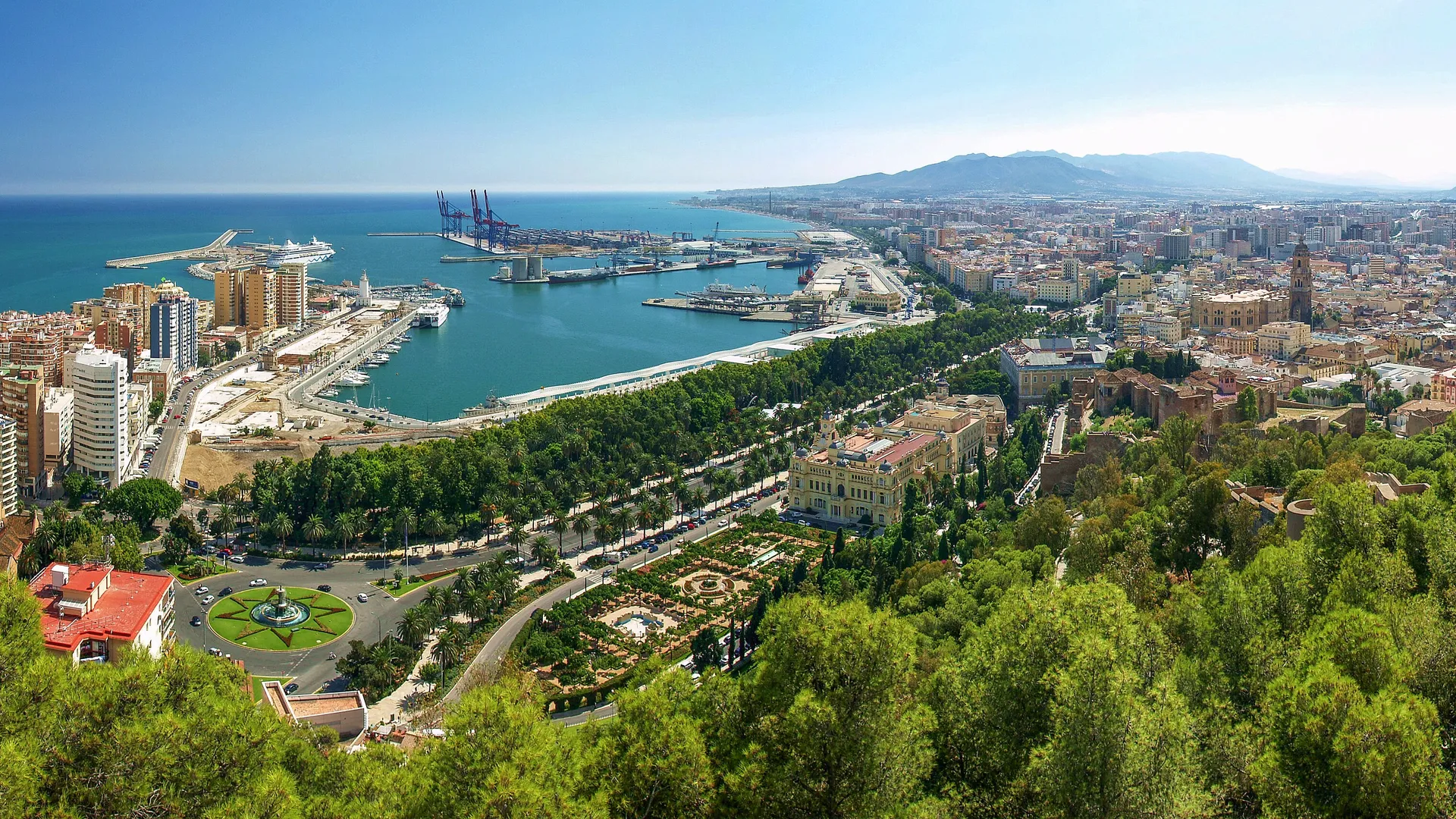
In short: Málaga is the second-largest city in Andalusia: a big city with a beach, an airport with lots of direct connections and a growing tech sector. It suits remote workers, self-employed people and families who want city life and are prepared for rising rents.
At a glance
- Population: 599,063 (INE, 1 January 2025)
- Rent: 16.5 € per m² (Idealista, September 2026)
- Purchase price: 3,969 € per m² (Idealista, September 2026)
- Climate: 18.5 °C annual average, 2,905 hours of sunshine (AEMET, Málaga Aeropuerto, 1981 to 2010)
- Airport: Málaga-Costa del Sol (AGP), connected to the city by Cercanías commuter train and bus
- Suits: remote work, tech jobs, families, students
- Difficult for: small budgets, anyone looking for peace and quiet in the centre
Who is Málaga right for?
- Good: remote workers will find coworking spaces, fast internet and lots of direct flights to Germany and Austria.
- Good: IT professionals have a real local job market with the Málaga TechPark.
- Good: families get big-city infrastructure, a beach in the city and a British school.
- Good: students have the Universidad de Málaga, a large university with its own campus.
- Not so much: if you earn little, you will feel the rents, which are higher than in many other cities in Andalusia.
- Not so much: if you are looking for quiet small-town life, you are better off on the coast or in the hinterland.
German-speaking doctors in Costa del Sol and Málaga: 15 verified practices and clinics →
Where to live?
| District / area | Rent €/m² | Suits |
|---|---|---|
| Centro (old town, Soho) | 17.5 | singles, couples without a car, culture lovers |
| Este (El Palo, Pedregalejo, El Limonar) | 17.9 | families, close to the beach, upmarket living |
| Carretera de Cádiz (Huelin) | 17.1 | everyday life with a beach, metro, a more Spanish environment |
| Teatinos | 14.5 | students, university staff, families who want a new build |
| Ciudad Jardín | 13.0 | smaller budgets, quiet residential area in the north |
Figures are Idealista averages for the city districts (September 2026); individual streets can differ considerably.
What does living there cost?
| Item | Per month |
|---|---|
| Rent for a 2-room flat (approx. 70 m²) | approx. 1,155 € |
| Utilities (electricity, water, internet) | approx. 150 € |
| Groceries (1 person) | approx. 300 € |
| Transport | approx. 40 € (bus and metro) |
| Total (1 person) | approx. 1,645 € |
The rent is calculated from the Idealista average (16.5 € × 70 m²); the other items are estimates. More on this under Cost of living in Spain.
Working
Tourism, hospitality, retail and construction shape the job market, plus the tech sector. At the end of 2025, around 29,000 people worked in a good 700 companies at the Málaga TechPark in Campanillas (El Español, March 2026). German speakers have opportunities in customer service, sales, IT and tourism, but without Spanish the choice remains small. For remote workers and the self-employed, Málaga is one of the most popular cities in Spain. More under Working in Spain, on becoming self-employed as an Autónomo or under Digital nomad in Spain.
Everyday life: climate, health, schools, transport
- Climate: in January, daytime highs average 16.8 °C, in August 30.8 °C, with 534 mm of rainfall per year (AEMET, Málaga Aeropuerto, 1981 to 2010). On some summer days the terral, a hot land wind, brings much higher temperatures.
- Health: the big public hospitals are the Hospital Regional Universitario de Málaga and the Hospital Universitario Virgen de la Victoria in Teatinos. More under Health insurance.
- Schools: The British School of Málaga in Cerrado de Calderón teaches children aged 3 to 18; the nearest German school is in Ojén near Marbella. More under with your family.
- Transport: the metro, city buses and the Cercanías line C-1 to the airport and Fuengirola are enough for everyday life; you only need a car if you live outside the city. The AVE high-speed train runs directly to Madrid from María Zambrano station.
First steps on arrival
-
Apply for your NIE
Book your appointment with the Policía Nacional in Málaga early via the Cita previa system, as free slots are scarce. Guide
-
Find a flat
Expect flats to go quickly and to pay a deposit plus an agency fee, especially in the Centro and the east. Guide
-
Register at the town hall
You complete the Padrón at the Ayuntamiento de Málaga, usually at one of the district citizen service offices. Guide
-
Open a bank account
All the major Spanish banks have branches in the city; online banks are often faster. Guide
-
Health card
With Padrón and social security, you get the card at the Centro de Salud responsible for your district. Guide
Typical mistakes
- Only searching in the Centro: Huelin, Teatinos or Ciudad Jardín are cheaper and well connected.
- Confusing holiday flats with regular flats: many offers in the centre are tourist rentals and only for a limited time.
- Underestimating the summer: without air conditioning, July and August in Málaga become exhausting.
- Equating the Costa del Sol with Málaga: Fuengirola or Marbella mean a different life, with a car and more foreigners.
Compare: Costa del Sol, Granada, Seville. Students will find more under Studying in Málaga.
Frequently asked questions
Is Málaga more expensive than the rest of Andalusia?
Yes, with rent at 16.5 € per m², the city is above most Andalusian cities (Idealista, September 2026). On the western Costa del Sol it is often even more expensive.
Do I need a car in Málaga?
Not in the city: the metro, buses and Cercanías cover everyday life. If you live on the outskirts or on the coast, getting around by car is much more convenient.
Can I get by without Spanish?
At first, yes: a lot of English is spoken in the centre. For the authorities, doctor’s visits and most jobs, however, you need Spanish.
Sources
- Idealista: rental price report Málaga
- Idealista: purchase price report Málaga
- INE: population of the municipalities in the province of Málaga
- AEMET: climate data Málaga Aeropuerto
- El Español: Málaga TechPark 2025 results
- NABSS: The British School of Málaga
- Renfe: Cercanías Málaga
As of: October 2026
Free
The moving checklist as a PDF (in German)
All steps in the right order to tick off. Plus the key tips by email over the next weeks (in German). Free, unsubscribe at any time.