In short: The Universidad de Almería is a young, manageable university with a single campus right on the Mediterranean. You pay 12.62 € per ECTS (757.20 € in the first year, as of October 2026) and rents that are among the lowest of Andalusia’s university cities. You get your place with the Abitur or Matura (German or Austrian school-leaving certificate) through UNEDasiss and the central Andalusian application. The catch is the location: Almería is far away from everything else.
At a glance
- University: Universidad de Almería (UAL), founded 1993, public
- Campus: one site in La Cañada de San Urbano, east of the centre by the sea
- Offer 2026/27: 34 Grados with 2,985 places for first-year students
- Tuition fees: 12.62 € per ECTS for the Grado, from the second year a 99 percent discount on passed credits
- Rent: 9.4 € per square metre (Idealista, September 2026)
- Language of instruction: mostly Spanish
The Universidad de Almería: one campus, short distances
The Universidad de Almería, UAL for short, has existed since 1993. Unlike in Granada, Seville or Málaga, it isn’t spread across the city: all faculties, the library, the sports facilities and the administration are on one site in La Cañada de San Urbano, a few kilometres east of the centre and right on the coast. Between two lectures you walk to the next building, and the beach is on your doorstep.
For the 2026/27 academic year the UAL offered 34 Grados with 2,985 places. Its centres include the faculties of Health Sciences, Experimental Sciences and Psychology as well as an engineering school. On top of that come law, economics, education and the humanities.
What the UAL stands for
The university has developed its profile from its surroundings. The province of Almería is one of Europe’s big vegetable growing regions, and the UAL accordingly does a lot of research on agriculture, food, the environment and sustainability. If you want to study agricultural engineering, biotechnology or environmental sciences, you’ll find a practical focus here that larger universities don’t offer in the same way. In recent years new degree programmes were added that were in high demand right away: medicine, physics, speech therapy and a Grado in Artificial Intelligence and Cybersecurity.
Language of instruction
Teaching is mostly in Spanish. The UAL recommends its visiting students B1 in Spanish or English, depending on the subject’s language of instruction, so some subjects are taught in English. For a full degree, though, you should assume that exams and your final thesis will be written in Spanish. Which subjects of your chosen programme are offered in English is shown in the curriculum on the UAL website. As everywhere in Andalusia, you must prove a foreign language at B1 level by the time you graduate.
Admission with the Abitur or Matura
Your school-leaving certificate is recognised in Spain, but you need your grade converted. This is done by UNEDasiss, a service of the Spanish distance-learning university UNED. With this certificate you apply through the Distrito Único Andaluz, the joint online procedure of all public universities in the region. There is no direct application to the UAL for the Grado.
-
Apply for the UNEDasiss certificate
Online, with your ID, school-leaving certificate and the grades of your last two school years. In 2026 the application window was open from 4 February to 1 December. The result is an access grade of at most 10 points.
-
PCE: yes or no?
The admission grade (nota de admisión) goes up to 14 points. The points above 10 only come from subject exams, the Pruebas de Competencias Específicas (PCE). In Almería you can manage without them in many subjects, but not in the health subjects.
-
Apply through the Distrito Único Andaluz
In 2026 the ordinary phase ran from 11 to 22 June, and the first allocation was published on 3 July. You list your preferred programmes in a binding order, including at several universities at once.
-
Secure your place
After each allocation you must enrol or reserve the place within a few days, in 2026 after the first round by 9 July. After that come further allocations and waiting list rounds until October.
The dates for 2027/28 have not been published yet. How UNEDasiss calculates, when the PCE take place and how the extraordinary phase works is explained in the main guide Studying in Spain.
Notas de corte at the UAL
The nota de corte is the grade of the last person admitted and is set anew every year. After the first allocation on 3 July 2026, the UAL published these values for the 2026/27 academic year:
| Grado | Nota de corte (out of 14) | Places |
|---|---|---|
| Medicine | 13.09 | 69 |
| Nursing (Enfermería) | 12.17 | 130 |
| Physiotherapy | 11.68 | 60 |
| Biotechnology | 11.23 | not stated |
| Mathematics | 11.18 | not stated |
| Physics | 11.07 | not stated |
| Sports science | 10.83 | not stated |
| Artificial Intelligence and Cybersecurity | 10.62 | not stated |
| Psychology | 10.28 | not stated |
| Speech therapy | 9.77 | not stated |
These are the ten subjects with the highest bar. Below them it quickly gets more relaxed: for the previous year 2025/26, the local press reported after the first allocation, for example, 8.92 for computer science, 8.73 for agricultural engineering, 7.94 for law and 6.48 for business administration. Several programmes, including tourism, environmental sciences, history and English studies, were open to anyone with a pass grade. If you narrowly miss out in Málaga or Granada, you often have good chances in Almería. That’s why it’s worth adding the UAL further down your list of preferences.
What does studying cost?
Fees are the same at all public universities in Andalusia and are among the lowest in Spain. As of October 2026:
- Grado, first enrolment: 12.62 € per ECTS, 757.20 € for 60 ECTS.
- Repeating a subject: 25.25 € per ECTS for the second enrolment, even more after that.
- Máster: 13.68 € per ECTS, professionally qualifying Másteres 12.62 €.
- Administration: 59.10 € for opening your file, 5.70 € for the student card.
On top of that comes the Andalusian 99 percent discount. From the second year, 99 percent of the price is waived for all credits you passed at the first attempt in the previous year. There is no income test. So in the first year you pay the full price, and afterwards, if your studies go well, almost nothing. You can pay in one sum, in two or in up to eight instalments.
For funding from home: Germans can apply for Auslands-BAföG (German state student funding for study abroad) for a complete degree in the EU, for Spain at the Studierendenwerk Heidelberg. Austrians can look into the Mobilitätsstipendium (mobility grant) of the Stipendienstelle, which is intended for a complete degree abroad.
Enrolment on site and language level
After the allocation comes the Matrícula, the actual enrolment with choice of subjects and payment. It runs through the UAL’s online portal, and the central student office on campus answers questions. The binding list of documents is in the university’s enrolment guidelines for your year of admission. Prepare the following:
- ID card or passport
- UNEDasiss certificate and allocation from the Distrito Único Andaluz
- bank details for payment, by direct debit for instalments
- from the second year, the declaration for the 99 percent discount
- the NIE, as soon as you have it
We haven’t found an official minimum Spanish requirement for admission to the Grado documented for Andalusia. That doesn’t mean you can do without. Lectures, group work and exams are in Spanish, and in Almería far fewer people speak English than in Málaga. Plan on a solid B2 when you start. The UAL’s Centro de Lenguas offers language courses, including Spanish for foreigners.
Housing for several years
When it comes to housing, Almería is one of the cheapest university cities in Andalusia. Idealista gives an asking price of 9.4 € per square metre for entire flats in September 2026. Among the eight cities only Jaén is cheaper (8.3 €), Málaga is at 16.5 €. A 70 square metre flat works out at around 660 €. That makes possible here what hardly works in Málaga: your own small flat or a two-person flatshare instead of a room in a five-person flatshare. The Idealista reports don’t give a documented average price for rooms in shared flats in Almería.
Neighbourhoods
Because the campus is outside the city, choosing a neighbourhood is a decision between being close to the university and city life.
- Centre: around the Rambla and the Paseo de Almería. Bars, shops, old town, but a bus ride to campus every day.
- Zapillo and Nueva Almería: residential areas by the city beach between the centre and the university. Popular with students because both stay within reach.
- La Cañada and Costacabana: right by the campus, quiet and practical during exams. Not much going on in the evenings.
Halls of residence
On its website the UAL lists the CIVITAS student residence, about five minutes from campus, as well as two other private residences (María Inmaculada and Carmen de Burgos). The university doesn’t publish prices there, so ask the residences directly. For private rooms and flats, the UAL’s housing service helps with the search and with finding flatmates.
For a degree lasting several years, sign a regular residential tenancy agreement. Then the legal deposit is one month’s rent. On the coast some landlords try to take students only from September to June so they can rent to holidaymakers in summer. What must be in the contract is explained in Finding a flat in Spain.
Monthly budget, side jobs and transport
The table is an estimated range for one person in a shared flat. The city’s rent level is documented, the other values are based on experience. With the calculator under Cost of living in Spain you can adjust them to your situation.
| Item | Per month | Basis |
|---|---|---|
| Room in shared flat | 250 to 350 € | Estimate based on rent level (9.4 € per square metre) |
| Utilities and internet (share) | 40 to 70 € | Estimate |
| Groceries | 180 to 250 € | Estimate |
| Bus | 15 to 30 € | Estimate, check fares with the city bus company |
| Mobile phone | 5 to 15 € | Tariff comparison 2026 |
| Leisure and other | 100 to 170 € | Estimate |
| Tuition fees (spread out, first year) | around 63 € | 757.20 € divided by 12 |
| Total | around 650 to 950 € | Estimated range |
Working alongside your studies
As an EU citizen you may work without a permit, but you need the NIE and a social security number. The job market in Almería is smaller than on the Costa del Sol, though. There are casual jobs in hospitality and retail, and in summer in tourism on the coast. With German you can offer tutoring and language lessons. Don’t rely on a side job to fund your studies, see it as extra income. The options are described in Working in Spain.
Transport
Almería has no metro and no tram. City buses run between the centre, the beach neighbourhoods and the campus. Current fares and student discounts are available from the municipal bus company. The city is flat along the coast, so many people cycle or ride a scooter to university. You don’t need a car for everyday life, but it’s handy for trips into the natural park. For trips home there is a small airport. Before deciding, check which connections there are from there to your home and what the alternative via a larger airport with an onward bus journey costs.
Life in Almería: what’s good and what’s missing
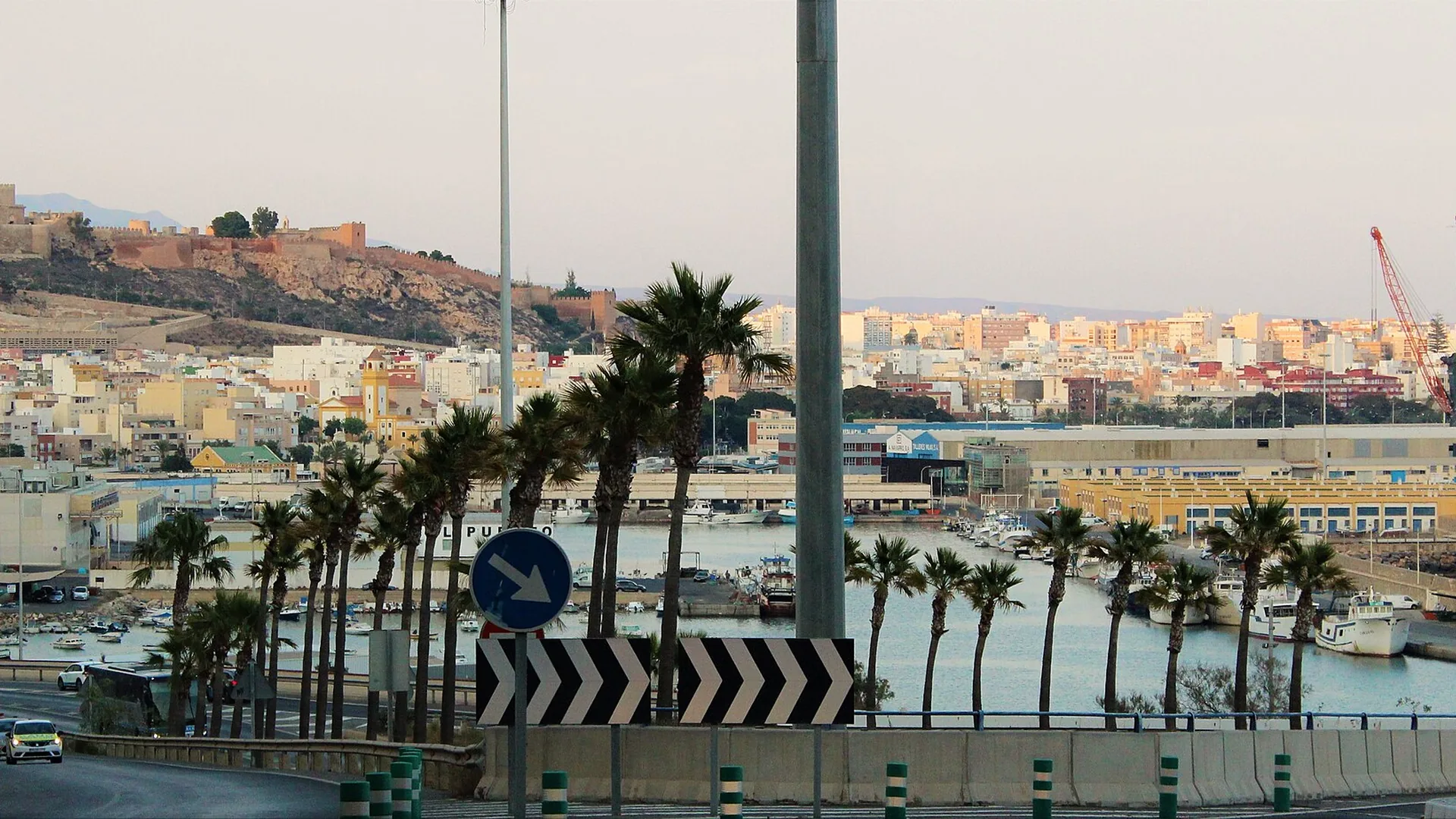
Almería is a port city in the far southeast of Andalusia with the driest climate on the Spanish mainland. It rarely rains, the winters are sunny and mild, and the swimming season is long. Above the old town stands the Alcazaba, one of the largest Moorish fortresses in Spain: see Almería sights. To the east begins the natural park with unspoilt coves, presented in the article Cabo de Gata. As in Granada, bars traditionally give you a tapa with your drink, which makes going out cheap.
The honest downside is the remoteness. Getting to Granada or Málaga by bus or car takes several hours, and rail connections are poor. The city is manageable, the cultural scene and nightlife are smaller than in the classic student cities, and there is little of an international scene. For a full degree that can be an advantage: you learn Spanish faster and are more likely to connect with locals. If you need a big city, you’ll get restless here after a year.
Paperwork for a degree lasting several years
For a degree over several years, it’s worth taking care of the basics right at the start.
- NIE: You need the foreigner identification number for employment contracts, many rental contracts and almost every dealing with the authorities. Step by step: Applying for the NIE.
- Padrón: By registering at the town hall you prove your residence in Almería. How it works is explained under Empadronamiento.
- Bank account: A SEPA account is enough for rent and fees. A Spanish account is more convenient for everyday life, mainly because of Bizum: Opening a bank account in Spain.
- Health insurance: The European Health Insurance Card (EHIC) from your insurer is valid in the public health system. Before you leave, discuss with your insurer what your cover looks like for a degree lasting several years and what happens if you take a job in Spain. More under Health insurance in Spain.
Only coming for one or two semesters? Then read Erasmus in Almería.
Frequently asked questions
Is it easier to get a university place in Almería?
In many subjects, yes. Medicine (13.09), nursing (12.17) and physiotherapy (11.68) were in high demand here too in 2026/27. For subjects such as law, business administration or tourism, however, the bar in the previous year was well below 10 points, so reachable without the PCE.
Can I study medicine in Almería?
Yes, the UAL offers medicine. In 2026/27 there were 69 places, and the nota de corte of the first allocation was 13.09 out of 14. Without very good PCE results it’s not achievable.
How far is the campus from the centre?
The campus is in La Cañada de San Urbano, a few kilometres east of the centre on the coast. You can reach it by city bus or by bike.
What does a room in Almería cost?
There is no documented average. The rent level for entire flats is 9.4 € per square metre (September 2026), far below Málaga. Roughly expect 250 to 350 € for a room in a shared flat and compare current listings.
Are there halls of residence?
Yes. The UAL lists the CIVITAS residence near the campus and two other private residences. You can get prices directly from the operators.
Who is Almería the right choice for?
For anyone who wants to live cheaply, learn Spanish quickly and have the sea and nature on their doorstep, and for anyone interested in agriculture, food or environmental topics. If you’re looking for a big city and short trips home, you’re better off in Málaga.
Sources
- Universidad de Almería: notas de corte of the first allocation 2026/27
- Universidad de Almería: accommodation
- Universidad de Almería: fact sheet (language level)
- Junta de Andalucía: Distrito Único Andaluz portal
- Junta de Andalucía: guide to the 99 percent discount
- La Voz de Almería: notas de corte at the UAL 2025/26
- Idealista: rental price report Andalusia, September 2026
Last updated: October 2026
Cover image: Elena Konovalova · Wikimedia Commons · CC BY-SA 4.0
Free
The moving checklist as a PDF (in German)
All steps in the right order to tick off. Plus the key tips by email over the next weeks (in German). Free, unsubscribe at any time.