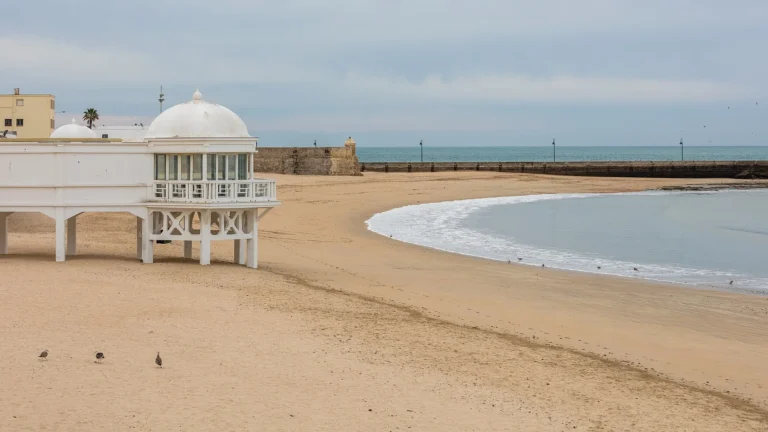
In short: Seville is one of the most popular cities for a semester abroad in Spain: big, beautiful, lively and with two public universities. Whether you end up at the Universidad de Sevilla or at the Universidad Pablo de Olavide depends on your department’s agreement. Take care of your Learning Agreement and room early, expect teaching in Spanish and expect intense heat at the beginning and end of the academic year.
At a glance
- Host universities: Universidad de Sevilla (US, faculties in the city) and Universidad Pablo de Olavide (UPO, one campus on the edge of the city)
- Lectures 2026/27: US 7 September to 18 December and 26 January to 24 May; UPO 14 September to 18 December and 25 January to 14 May
- Deadlines: US registration by your home university 2 March to 30 June 2026; UPO nomination by 30 April, application by 29 May 2026
- Funding 2026/27: 540 € a month from Germany, 470 € from Austria
- Housing: rooms in shared flats, no placement by the universities
- Language: almost everything in Spanish, plan on B1 as a minimum
Why Seville, and who is it less suited to?
Seville is the largest city in Andalusia and still feels manageable. You live between the cathedral, the Alcázar and the Guadalquivir, life happens outdoors, and in the evenings the squares are full. According to the local ESN section, more than 2,000 international students come to the city every year. So you will quickly find people to connect with.
That is exactly the downside too. If you live in a flat with only exchange students and only go to international evenings, you end up speaking more English than Spanish. Seville is also less suitable if you do not cope well with heat, want a beach on your doorstep or have a tight budget: rents are higher than in Granada, Córdoba, Huelva and Jaén. And if you need courses in English, you will hardly find any here.
US or UPO: the difference in everyday life
At the US you study right in the city, depending on your subject in the old tobacco factory, in Ramón y Cajal, Reina Mercedes, Macarena or on La Cartuja. At the UPO you take the metro to a campus on the south eastern edge of the city, where everything is close together. You cannot choose freely: what counts is which of the two universities your department has an agreement with.
Process: from application to Transcript of Records
The process starts around a year before departure at your home university. The host university only comes into play once you have been nominated.
-
Application at your home university
You apply to your department’s Erasmus coordinator or to the International Office for a place in Seville. Each university sets its own internal deadlines, which are often many months before the start. Ask early.
-
Nomination
Your university registers you in Seville. At the US, it enters you itself in the university’s Secretaría Virtual: for the first semester and the full year 2026/27, this was possible from 2 March to 30 June 2026. For a start in the second semester, the US Faculty of Law gives October to November as the period. The UPO requires the nomination by email by 30 April, for both semesters and the full year.
-
Registration at the host university as an incoming student
US: after registration you receive your login (UVUS) by email and later download your letter of acceptance from the platform. UPO: you fill in the online form, which for 2026/27 was open until 29 May 2026, and then you receive the letter of acceptance.
-
Learning Agreement
You agree with both universities which courses you will take and what will be recognised. Watch out at the US: every faculty has its own rules. For 2026/27 the Faculty of Law accepted the Learning Agreement from 15 May to 31 July (second semester: 3 November to 18 December), requires course codes and course names and does not accept signatures via the OLA platform. Ask your faculty’s coordinator.
-
Arrival
The US recommends arriving at least one week before lectures start. You go to the Centro Internacional (Avenida Ciudad Jardín 20 to 22) and get your arrival certificate. Bring copies of your ID and proof of insurance. The UPO holds welcome events at the start of each semester, and the dates are sent by email.
-
Enrolment on site
US: you enrol at your faculty’s office, but only once the Learning Agreement has been signed by all three parties. The Faculty of Law gave 1 to 18 September 2026 and 11 January to 12 February 2027 for this, plus a fee of 6.82 €. UPO: course selection takes place online in advance, for 2026/27 from 1 to 10 July.
-
Departure and Transcript of Records
At the US you check out at the Centro Internacional. You download your transcript yourself as a signed PDF from the university’s online portal, as it is no longer sent out. It is only complete once the grades have been officially entered. Factor this in for recognition at home.
Semester dates, courses and exams
The Spanish academic year starts earlier than in Germany and Austria. If you come for the winter semester, you need to be there at the beginning of September. If you come for the summer semester, you start at the end of January, right in the middle of the German exam period.
| 2026/27 | US | UPO |
|---|---|---|
| Lectures 1st semester | 7 September to 18 December | 14 September to 18 December |
| Exams 1st semester | 8 to 25 January | in January, dates per faculty |
| Lectures 2nd semester | 26 January to 24 May | 25 January to 14 May |
| Exams 2nd semester | 25 May to 14 June | from mid May, dates per faculty |
| Resit period | 28 June to 10 July | until mid July |
Important for your trip home: the first semester exams take place after Christmas. Only book your return flight once you know your dates. At the US there are also no classes during Holy Week (21 to 28 March 2027) and Feria week (12 to 18 April 2027).
How do Spanish exams work?
Each subject has several exam sittings per academic year, the convocatorias. The first is right after the semester, the second is the resit period in June or July. Many subjects also have continuous assessment (evaluación continua) with attendance, assignments and mid term tests. Grades go from 0 to 10, and you pass from 5. If you fail a first semester subject and leave in February, you would have to come back in summer for the second sitting. Sort this out before choosing your courses.
Course selection
Only choose courses that take place in your semester: C1 stands for the first semester, C2 for the second. At the US Faculty of Law, for example, first year subjects are closed to exchange students, and you can only apply for courses at other faculties after you arrive. Your final enrolment must match the signed Learning Agreement, and changes need a new signature. Expect popular groups to be full and have backup courses ready.
Language and language courses
The language of instruction is Spanish. On the required level, the US refers to the agreement between the universities, and your home university confirms during the nomination that you meet it. The UPO recommends at least B1 and points out that only one business degree is taught in English and that places in English courses are limited.
Both universities offer Spanish courses. At the US they run through the Instituto de Idiomas, and you sign up separately from the faculty using a dedicated form. The UPO runs its courses through its own language programme, and you receive the dates and prices with the documents for incoming students. To be honest: with B1 you will get by in everyday life, but a lecture with an Andalusian accent will be hard work at first. Every month of preparation at home pays off.
Housing for five to ten months
Neither university arranges rooms. The US offers advice through its student service SACU, and the UPO refers you to its halls of residence and to a search platform for student rooms. A room in a shared flat is the usual option.
When and where to look?
Most rooms are let in July and early September for the first semester and in January for the second. A tried and tested approach is to book a hostel for the first week and view rooms on site. These neighbourhoods are popular with students:
- Nervión and Viapol: lots of flatshares, close to Ramón y Cajal, with the metro to the UPO.
- Reina Mercedes and Bami: right by the US south campus.
- Triana and Los Remedios: across the river, lively, with the metro.
- Macarena and Alameda: close to the nightlife, older, often a bit cheaper.
- Montequinto: a suburb with the metro, really only practical for the UPO.
How much does a room cost?
Idealista does not publish a separate figure for rooms in shared flats in Seville. The Spanish average in the first quarter of 2026 was 430 €. Whole flats in Seville cost 13.4 € per square metre (September 2026), which is significantly more than in Granada (10.8 €) and less than in Málaga (16.5 €). If you only stay for one semester, you often pay a premium for the short term.
Costs and funding
You pay no tuition fees in Seville, as you remain enrolled at your home university. The Erasmus grant covers part of your living costs, not all of them.
- From Germany: Spain is in country group 2, which means 540 € a month in 2026/27. Many universities only fund a fixed number of months per semester.
- From Austria: 470 € a month for study stays in 2026/27.
- Top-ups: an extra 250 € a month for students with fewer opportunities, for example with a child, a disability or a chronic illness. Your university will tell you the exact criteria.
- Travel: if you travel by train or bus, you can get additional funded travel days and a higher travel allowance.
- Auslands-BAföG (Germany’s state student funding for studying abroad): can be combined with Erasmus. The Studierendenwerk Heidelberg is responsible for Spain, and it is best to apply six months in advance.
Monthly budget
There are no official figures for exchange students in Seville. The table mixes sourced values and estimates, which are marked as such.
| Item | Per month | Basis |
|---|---|---|
| Room in a shared flat | 380 to 520 € | Estimate for a short tenancy, Spanish average 430 € |
| Utilities and internet | 40 to 70 € | Estimate |
| Groceries | 200 to 280 € | Estimate |
| Bus | 11.40 € | Tussam, monthly student pass 2026 |
| Mobile phone | 5 to 10 € | Prepaid tariffs 2026 |
| Going out, day trips, travel | 150 to 300 € | Estimate |
| Total | around 790 to 1,190 € | own calculation |
So the funding covers roughly half. The bus is cheap: a single ticket costs 1.40 €, a 30 day pass 21.20 €, and for students 11.40 € a month (as of 2026). To get to the UPO, take the metro to the Pablo de Olavide station or bus line 38 from Prado de San Sebastián.
Student life: ESN, tapas and day trips
Seville has two sections of the Erasmus Student Network. ESN Sevilla has existed since 1992, holds office hours at the US Centro Internacional and offers the ESNcard, a buddy programme, trips and cultural evenings. ESN UPO has been an official section since 2017 and is run by students of Pablo de Olavide. Both are the quickest way to make your first contacts.
For everyday life beyond the Erasmus bubble: go to the bars of the Alameda and Triana, order tapas at the counter and join a language tandem group. What the city has to offer is covered in Things to see in Seville, and what ends up on your plate in Andalusian food. If you are there in the summer semester, you will experience Holy Week and the Feria de Abril: see Festivals in Andalusia.
Seville is a good base for weekends. By train you can quickly get to Córdoba, Jerez and Cádiz. For the Atlantic, head to the Costa de la Luz.
Paperwork: what you really need
For one or two semesters the list is short.
- Insurance: the US requires health insurance that includes repatriation and also recommends the European Health Insurance Card (EHIC). The EHIC alone does not cover repatriation, so take out travel health insurance for the whole duration.
- ID: ID card or passport, valid beyond the end of your stay.
- NIE: for one semester you usually do not need the foreigner identification number. It becomes necessary if you work or if a landlord or bank insists on it. Then Applying for an NIE will help.
- Account: your account from Germany or Austria is usually enough. A card without foreign transaction fees saves money.
Checklist before you fly
- Learning Agreement signed by all three parties, as a PDF and printed
- Letter of acceptance from the host university
- EHIC and travel health insurance policy, each with a copy
- ID and two copies, a few passport photos
- Grant Agreement signed with your home university
- Accommodation booked for the first nights
- Credit or debit card without foreign transaction fees
- Sun protection for September and June, a warm layer for the unheated flat in January
You want to stay for more than a semester and do your whole degree in the city? Then read Studying in Seville.
Frequently asked questions
Can I choose whether I go to the US or the UPO?
Only if your department has agreements with both. Check your university’s list of partners. Most departments have one of the two partners in Seville.
When do I need to be in Seville at the latest?
For the first semester of 2026/27, lectures started on 7 September at the US and on 14 September at the UPO. The US recommends arriving a week beforehand. The second semester starts at the end of January.
Is English enough for a semester in Seville?
Hardly, as far as the university goes. Almost all courses are in Spanish, and at the UPO English courses are limited to one business degree and fill up quickly. Plan on B1 as a minimum.
How hot does it really get?
In September and from June onwards, days around 40 degrees are normal. From October to May the weather is mild and usually sunny. Flats rarely have heating, so it gets chilly indoors in January.
Do I need an NIE for one semester?
Mostly not. For enrolment and everyday life your ID is enough. Only with a job or if a landlord or bank asks for it do you need to apply for one.
Will I get a place in a hall of residence?
Do not count on it. The universities do not arrange rooms, halls with meals are more expensive than a shared flat and rarely available for one semester. Look for a room in a shared flat.
Sources
- Universidad de Sevilla, Centro Internacional: Guidance on nominating incoming students 2026/27
- Universidad de Sevilla, Facultad de Derecho: Rules for incoming students 2026/27
- Universidad de Sevilla: Academic calendar 2026/27
- Universidad Pablo de Olavide, ARIC: Information for selected incoming students
- Universidad Pablo de Olavide: Academic calendar for bachelor’s degrees 2026/27
- ESN Sevilla: Erasmus Student Network
As of: October 2026
Cover image: Benjamin Smith · Wikimedia Commons · CC BY-SA 4.0
Free
The moving checklist as a PDF (in German)
All steps in the right order to tick off. Plus the key tips by email over the next weeks (in German). Free, unsubscribe at any time.