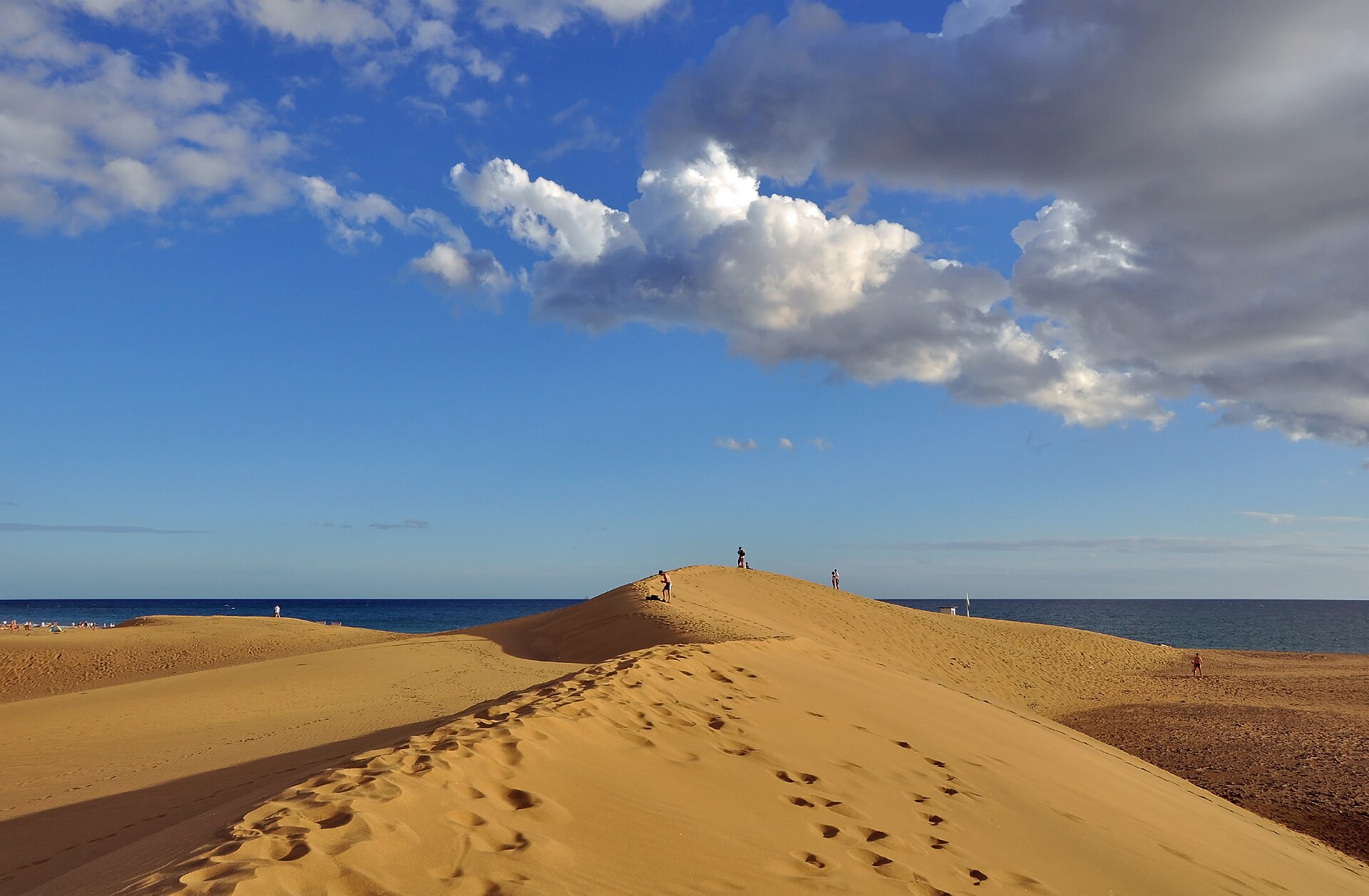
In short: The Maspalomas Dunes are a protected sea of sand right on the Atlantic, between Playa del Inglés and the Maspalomas lighthouse. Visiting costs nothing. Go early in the morning or late in the afternoon, stay on the marked paths and take more water than you think you need.
At a glance
- Location: south of Gran Canaria, municipality of San Bartolomé de Tirajana
- Admission: free, open at all times
- Protection status: Reserva Natural Especial (special nature reserve)
- Best time: shortly after sunrise or at sunset
- What to bring: water, a hat, sunglasses, shoes for the hot sand
What can you expect in the dunes?
The reserve has three parts: the dune field, the La Charca lagoon and a palm grove. The wind constantly reshapes the sand hills, so the area looks a little different every time you visit.
- The dune field: pale sand in waves and ridges, with the sea behind it. From the high dunes you can see all the way to the mountains on a clear day.
- La Charca: a brackish lagoon on the western edge and a resting place for birds on passage. You can look in from the path, but you are not allowed to enter it.
- Faro de Maspalomas: a 19th century lighthouse at the end of the Meloneras promenade. This is where Maspalomas beach begins.
How do you get in?
There are several access points. Which one suits you depends on whether you just want to look, walk through the sand or swim.
- Viewpoint in Playa del Inglés: At the southern end of town, on the edge of the dunes, there is a mirador with a view over the whole field. It is the best spot for sunset and the starting point of a marked path.
- From the lighthouse: From the Faro you walk east along the water, with the dunes on your left and the sea on your right. This is the easiest route, because the sand along the waterline is firm.
The Global bus company’s public buses take you to Playa del Inglés and the lighthouse from Las Palmas and from the airport. If you come by car, park in the streets of Playa del Inglés or near Meloneras.
What rules apply in the reserve?
The dunes have been losing sand for decades, and every step off the paths damages the plants that hold it in place. That is why you are only meant to walk on the marked paths and on the beach. Violations can result in a fine.
- Stay on the paths marked with posts and do not walk across the ridges.
- Do not build windbreak walls out of stones and do not pull up plants.
- Do not enter La Charca or the fenced-off areas.
- Drones only with a permit.
The island government, the Cabildo de Gran Canaria, publishes the current regulations. Information boards stand at the access points.
When is the best time?
The light makes all the difference. In the morning and evening the ridges cast long shadows, the sand glows golden and it is pleasantly cool. At midday the light is harsh, the sand burns under your feet and there is no shade anywhere.
About the climate: at the AEMET station at Gran Canaria Airport, the average daily maximum is 20.8 °C in January and 27.5 °C in August (reference period 1981 to 2010). In the sand it feels much hotter. Monthly figures are in the article Canary Islands weather.
Tips for walking through the sand
The route looks short on the map. In soft sand, though, you only make slow progress, and going uphill you slide back with every step.
- Take at least one litre of water per person, more in summer.
- Going barefoot works well in the morning. As soon as the sun is high, you need sandals or light shoes.
- With small children, it is better to walk along the water from the lighthouse than straight across the dune field. Pushchairs cannot be pushed through the sand.
- On the beach between the two towns there are designated nudist sections. Signs show where they begin.
- You can swim at the beach. Watch the flags, as there are currents at the headland.
What can you combine it with?
A morning in the sand works well, followed by the beach and the Meloneras promenade in the evening. More places to visit are listed under Gran Canaria sights, and the swimming spots under Beaches on Gran Canaria. If you want to stay longer in winter, read Wintering in the Canary Islands.
Frequently asked questions
Is there an admission fee for the Maspalomas Dunes?
No. The area is freely accessible, with no ticket office and no opening hours.
Can you walk anywhere in the dunes?
No. You are meant to use the marked paths and the beach. Off them you harm the reserve and risk a fine.
How long does a visit take?
Half an hour is enough for the viewpoint. For the walk through the dunes or along the beach to the lighthouse, allow half a morning.
Are the dunes suitable for children?
Yes, children love the sand. Go early, stay close to the access point and remember water and sun protection. More tips under Canary Islands with kids.
Sources
- AEMET: climate data for Gran Canaria Airport, 1981 to 2010
- Fred. Olsen Express: ferry connections to Gran Canaria
- Binter: flights to Gran Canaria
Last updated: October 2026
As of October 2026. Opening hours, prices and entry rules change. Check them on the official websites before your visit.
Cover image: Marc Ryckaert (MJJR) · Wikimedia Commons · CC BY 3.0
Free
The moving checklist as a PDF (in German)
All steps in the right order to tick off. Plus the key tips by email over the next weeks (in German). Free, unsubscribe at any time.