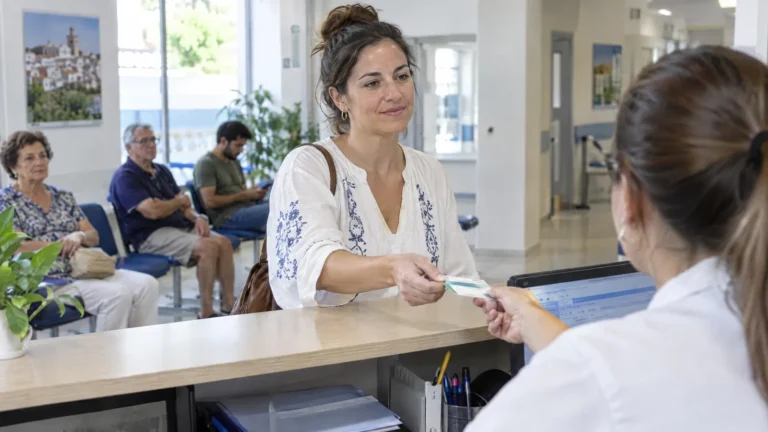
In short: Your pension from Germany or Austria is also paid out in Spain. You stay covered by your health insurer back home and use the Spanish health system with form S1. As a resident you generally pay tax in Spain. On German statutory pensions, Germany may additionally levy up to 5 % or 10 %, depending on when your pension started.
At a glance
- Pension: continues to be paid within the EU, a proof of life is required once a year
- Health insurance: form S1 from your health insurer, presented in Spain to the social security institute INSS
- Taxes: tax resident in Spain once you spend more than 183 days there in a calendar year
- Tax allowance in Spain: 5,550 € per year, 6,700 € from age 65, 8,100 € from age 75
- Inheritance tax: reduced by 99 % in Andalusia and by 99.9 % in the Canary Islands for close relatives
- To test it: spend a winter first, then decide
How does your pension reach Spain?
You’re in good company: the Deutsche Rentenversicherung (German statutory pension insurance) pays more than 1.7 million pensions to people abroad, mainly to Italy, Spain and Austria. Within the EU, the pension is usually transferred to an account in your country of residence.
Pension from Germany
- One application is enough: even if you have worked in several countries. If you already live in Spain, you submit it there, and the other institutions are involved automatically.
- Life certificate: once a year. In many countries this works through a digital data match, otherwise by reply form or digitally with the POSTIDENT app.
- Information: free service hotline of the pension insurance on 0800 1000 4800.
Pension from Austria
- Payment: monthly in arrears on the 1st of the following month to a bank account. Payment by cheque is not available.
- Life confirmation: every year by mid-June. If it is missing, the Austrian pension insurance (Pensionsversicherung) provisionally suspends payment.
- Reporting duties: changes of address, name or marital status within 2 weeks, earned income within 7 days.
Get the information at least six months before your pension starts. If you have worked in several EU countries, each country only pays its share from its own retirement age. A Spanish account makes many things easier, see Opening a bank account.
How are you covered for health?
In the EU, the country that pays the pension is responsible for a pensioner’s health insurance. If you only receive a German or Austrian pension, you stay insured through your current insurer. Form S1 transfers your entitlement to Spain.
-
Apply for the S1 at your health insurer
Ideally before the move. Family members can be covered on the same form.
-
Register in Spain
Present the S1 without delay to the Spanish social security institute INSS. At the same time, take care of the NIE and the Padrón (registration at the town hall), because you’ll need both for the health card at the latest.
-
Get your health card
With the INSS confirmation and the Padrón, you apply for the health card at the health centre (centro de salud) in your neighbourhood. That’s also where you get your GP.
You receive all benefits in kind such as doctors, treatment and hospital under the same conditions as people insured in Spain. Your insurer back home covers the costs. Important: the scope follows Spanish law, not what you know from home. For medicines, pensioners in the Spanish system pay 10 % themselves, with a monthly cap depending on income. The health centre will tell you which band you fall into with the S1.
When visiting your home country, as a pensioner from Germany or Austria you can continue to be treated there under the usual conditions. All ways into the system, including for people without an S1, are explained in Health insurance in Spain.
Where do you pay tax on your pension?
If you spend more than 183 days in Spain in a calendar year, you are tax resident there. Short absences are included. Which country may tax your pension is then governed by the treaty between Spain and your home country.
Pension from Germany
Under the 2011 treaty, Spain taxes as the country of residence. On statutory pensions, Germany may additionally levy a limited tax, which Spain credits. What counts is the year in which you first received a pension.
| First pension payment | Maximum German tax |
|---|---|
| up to 31 December 2014 | none, only Spain taxes |
| 2015 to 2029 | 5 % of the gross amount |
| from 2030 | 10 % of the gross amount |
- Private and occupational pensions: generally only taxable in Spain.
- Civil servant pensions: are generally taxed in Germany.
- Responsible tax office: For everyone living abroad and receiving only pensions from Germany, the Finanzamt (tax office) Neubrandenburg is the central point of contact (phone +49 385 588-47000).
Pension from Austria
A separate, older treaty applies between Austria and Spain. Which country taxes depends on the type of pension, above all on whether it comes from private employment or from a public position. The Austrian pension insurance points out that a certificate of residence may be needed to apply the treaty. Before the move, get written confirmation from your tax office of how your pension will be treated.
How much does Spain take?
Spanish income tax consists of a state part and a regional part. The state scale starts at 9.5 % (up to 12,450 €) and ends at 24.5 % (above 300,000 €). On top of that comes a regional part of roughly the same size. Together, the marginal tax rate in 2026 ranges from 19 % to 47 % in Andalusia and from 18.5 % to 50.5 % in the Canary Islands. The personal basic allowance is 5,550 € per year, 6,700 € from age 65 and 8,100 € from age 75.
As a resident you also have to declare assets abroad in a separate information return (Modelo 720). This covers accounts, securities accounts and property in Germany or Austria. The thresholds are explained in Taxes in Spain.
Inheritance tax and will: what should you sort out?
In Spain, inheritance tax is set by the regions. Andalusia and the Canary Islands are among the most favourable.
- Andalusia: 99 % reduction of the tax for children, spouses and parents. In addition, the taxable base for these groups is reduced by up to 1,000,000 € per heir. Siblings, nephews and nieces and non-relatives don’t get the reduction.
- Canary Islands: 99.9 % reduction, in case of inheritance also for siblings, nephews and nieces, uncles and aunts.
Whether tax is also due in Germany or Austria depends on your case and should be checked before the move. Separate from tax law is the question of who inherits. Under EU law, the inheritance law of the country where you last habitually lived generally applies, so Spanish law after the move. Instead, you can choose the law of your nationality, explicitly in your will or in a separate declaration. This choice governs heirs and compulsory shares, not inheritance tax.
Also think about an advance healthcare directive. Andalusia keeps its own register for this (Declaración de Voluntad Vital Anticipada), and so do the Canary Islands (Manifestación Anticipada de Voluntad). It makes sense to make a Spanish one in addition to the one from home.
Spend a winter first, then move?
The best test is a winter on site. You get to know the place, the flat and the doctors without giving anything up at home. At Gran Canaria airport, the January average is 17.9 °C. Ideas for this are under Wintering in the Canary Islands.
- Taxes: Stay under 183 days in the calendar year if you don’t want to become resident in Spain. Keep count of the days.
- Health insurance: The European Health Insurance Card only covers medically necessary treatment in the public system, not private doctors.
- Rent: For a few months you get a seasonal contract with two months’ rent as a deposit.
Paperwork we take care of for you:
- NIE number (from 190 €)
- Town hall registration (Padrón) (120 €)
- Health card and GP (150 €)
- Bank account and Bizum (150 €)
- Taxes and tax residence (via Gestoría)
- Vehicle re-registration and buying a car (from 390 €)
Frequently asked questions
Will my German pension be reduced if I move to Spain?
No. If you live elsewhere in the EU, the German pension is generally paid in full. There may be an exception for certain reduced earning capacity pensions.
What is form S1?
With the S1, your health insurer confirms that you are insured with them and are entitled to benefits in your country of residence. You present it to the INSS in Spain and then use the public health system. Your insurer covers the costs.
Do I have to pay tax on my pension in Spain?
Yes, if you are tax resident in Spain, meaning you live there for more than 183 days in a calendar year. On German statutory pensions, Germany additionally levies up to 5 % or 10 % depending on when your pension started, which Spain credits.
What happens if I receive pensions from two countries?
If you also receive a Spanish pension and live in Spain, Spain is responsible for your health insurance. In that case you don’t need the S1.
Will my children pay inheritance tax in Spain?
In Andalusia and the Canary Islands, almost nothing remains for children and spouses: the tax reduction is 99 % in Andalusia and 99.9 % in the Canary Islands. Whether additional tax is due in your home country must be checked case by case.
Sources
- Deutsche Rentenversicherung: Pensions abroad
- Pensionsversicherung Österreich: Austrian pension abroad
- Your Europe: Health insurance when living abroad
- Agencia Tributaria: Leaflet on income from Germany
- Finanzamt Neubrandenburg: Pensions abroad
- Gobierno de Canarias: 99.9 % reduction of inheritance tax
Last updated: October 2026
Cover image: see source · Wikimedia Commons · CC BY-SA 3.0
Rather do it yourself?
Playbook: Health insurance and health card
How to get into the Spanish public health system: the right route for your situation, the transition period, the health card in Andalusia and the Canary Islands, your GP and ClicSalud+. 21 pages, PDF in German.
Free
The moving checklist as a PDF (in German)
All steps in the right order to tick off. Plus the key tips by email over the next weeks (in German). Free, unsubscribe at any time.