In short: Huelva is the affordable, quiet choice for a semester abroad in Andalusia: a small university, short distances and Atlantic beaches 30 to 40 minutes away by bus. The Universidad de Huelva does not require a language certificate, offers some courses in English and quotes 250 to 375 euros a month for a room in a shared flat. If you are looking for a big city and a huge Erasmus programme, you are better off in Seville.
At a glance
- Host university: Universidad de Huelva (UHU), just under 12,000 students, around 15 percent international
- Deadlines 2026/27: nomination by 15 June and application by 1 July (autumn), nomination by 15 November and application by 30 November (spring)
- Welcome Week: 7 to 11 September 2026 and 18 to 22 January 2027
- Language: no certificate required, B2 in Spanish or English recommended
- Room: 250 to 375 euros a month including utilities (university figure)
- Funding 2026/27: 540 euros per month from Germany, 470 euros from Austria
Why Huelva, and who is it not for?
Huelva is at the top of hardly anyone’s wish list, and that is exactly its appeal. The city has around 145,000 inhabitants, hardly any tourism and few people who will speak English with you. Your Spanish will improve faster here than in any big Erasmus city. Your funding goes further, because rooms and going out cost little. And the university is small enough that lecturers and the international office know who you are.
Then there is the location: Atlantic beaches, Doñana National Park, the Algarve just across the border and Seville in just over an hour.
Huelva is not a good fit if you expect a big programme, clubs and a guidebook old town every evening. The city is unspectacular, the outskirts have an industrial port and chemical plants, and many Spanish students go home at weekends. There is no airport. If you see that as a drawback, be honest with yourself and choose another city.
The process: step by step to Huelva
The UHU describes admission in three steps: nomination, confirmation, pre-registration. Before and after that comes everything any semester abroad requires.
-
Application at your home university
You apply to your department or international office for a place in Huelva. This requires an agreement between your university and the UHU. Internal deadlines vary from university to university and are often almost a year before departure.
-
Nomination
Your university sends the official nomination by email to the UHU international office. Deadlines for 2026/27: 15 June 2026 for autumn, 15 November 2026 for spring.
-
Registration as an incoming student in UMove
After the review, you receive an information pack by email and complete the pre-registration on the UMove mobility platform. The application deadline for 2026/27 was 1 July 2026 (autumn) and 30 November 2026 (spring). The letter of acceptance and the Learning Agreement are also handled via UMove.
-
Learning Agreement
You choose courses from the UHU list and agree them with your home university. The UHU allows a maximum of 30 credits per semester plus 6 credits for a Spanish course. It does not set a minimum; that is up to your home university.
-
Arrival and Welcome Week
In 2026/27 the Welcome Week took place from 7 to 11 September and from 18 to 22 January. During this week you receive your university username, password and email address for Wi-Fi and the Moodle learning platform.
-
Enrolment on site
To enrol, you have to show the European Health Insurance Card or private health insurance for the entire stay. Without proof, the university will not enrol you.
-
Departure and Transcript of Records
After the exams, the university issues your transcript as soon as the grades have been entered. For the first semester of 2026/27, the latest date for entering grades is 12 February 2027, and for the second it is 11 June 2027. Before you leave, have the length of your stay confirmed, which your home university needs for the funding.
Semester dates, courses and exams
The UHU starts early and finishes early. The second semester already begins in January. If you are coming from Germany, you will usually have to take exams at home earlier or postpone them.
| 2026/27 | 1st semester | 2nd semester |
|---|---|---|
| Welcome Week | 7 to 11 September | 18 to 22 January |
| Lectures | 11 September to 22 December | 25 January to 12 May |
| First exam period | 11 to 22 January | 20 to 31 May |
| Second exam period | 14 to 25 June | 5 to 16 July |
There are no classes over Christmas (23 December to 6 January), during Holy Week (22 to 26 March 2027) and on the days of the pilgrimage to El Rocío (13 to 18 May 2027).
How do the exams work?
Spanish universities offer several exam periods per subject, the convocatorias. The first is right after the semester. In Huelva, the second one, the resit period, only takes place in June for first-semester subjects. If you leave in February and have failed a subject, you would have to come back for it. Many subjects also have continuous assessment with assignments, presentations and attendance that make up part of the grade. Grades go from 0 to 10, and 5 is a pass.
Choosing courses
Only choose subjects from your semester: C1 for the first, C2 for the second. Courses are taught in Spanish, in English or in both languages. The UHU publishes a list of subjects in English, which is not a given in Andalusia. Still, do not count on putting together a full timetable in English: the choice is small depending on the faculty, and timetables overlap. Also check the location. Engineering subjects are held in La Rábida, outside the city.
Language and language courses
The UHU does not require a language certificate for the application. It recommends B2 in Spanish or English, depending on the language of your courses. Your home university may have stricter requirements.
The university’s Servicio de Lenguas Modernas offers Spanish courses at levels A1 to C1. A course is worth 6 ECTS and can be added to the Learning Agreement on top of the 30 credits. The university does not give prices in the fact sheet, so ask when you register. Take the course: in Huelva you need Spanish for landlords, authorities, the supermarket and the bar. The university itself points out that most property owners only speak Spanish.
Housing for five to ten months
The international office does not arrange rooms, but it does give advice and provides a housing guide. The university describes the market as affordable, and compared with other Andalusian university cities, that is true.
What does a room cost?
According to the 2026/27 fact sheet, you pay 250 to 375 euros a month including utilities for your own room in a shared flat. Whole flats cost 10.7 euros per square metre (Idealista, September 2026), 13 percent more than the previous year. The days of rooms for well under 200 euros are over.
Which neighbourhoods?
- Los Rosales and Fuentepiña: five minutes’ walk to the El Carmen campus, usually the cheapest.
- Avenida de Andalucía: also close to the campus, with good buses to the centre.
- Isla Chica: lively residential area between the centre and the campus.
- Centre: the most expensive, but with bars and shops on your doorstep and short distances to La Merced.
When and how to look?
Many exchange students book temporary accommodation for the first few days and look on site. Among other options, the university mentions the city’s youth hostel, which gives students a discount. For long-term rentals it recommends the big portals Idealista and Fotocasa, the housing list of the SACU student service and groups on social networks. Its own advice: move in with Spanish students, because that helps your language the most. Residence halls with full board cost about twice as much as a room and are rarely worth it for one semester.
Costs and funding
You do not pay tuition fees at the UHU, as you remain enrolled at home. Erasmus funding for Spain is the same everywhere, but in Huelva it goes further than in Seville or Málaga.
- From Germany: 540 euros per month (country group 2, 2026/27). Some universities limit the funded months per semester.
- From Austria: 470 euros per month for study stays in 2026/27.
- Top-up: 250 euros per month for students with fewer opportunities; your university will tell you the criteria.
- Green travel: If you travel by train or bus, you get additional funded travel days and a higher travel allowance. To Huelva this is a long but doable journey.
- Auslands-BAföG (German state funding for studying abroad): can be combined with Erasmus; the responsible office for Spain is the Studierendenwerk Heidelberg. Submit the application six months in advance if possible.
Monthly budget
The university quotes 450 to 500 euros a month for rent, utilities, food and transport. That works with a cheap room and few trips. With travel and going out, the numbers look like this:
| Item | Per month | Basis |
|---|---|---|
| Room in a shared flat including utilities | 250 to 375 euros | Universidad de Huelva, fact sheet 2026/27 |
| Groceries and canteen | 180 to 250 euros | Estimate; canteen menu 6.55 euros |
| City bus | 15 to 30 euros | Estimate |
| Mobile phone | 5 to 10 euros | Prepaid plans 2026 |
| Going out, beach, weekend trips | 120 to 250 euros | Estimate |
| Total | around 570 to 915 euros | own calculation |
In the university cafeteria, tapas cost 2 to 2.50 euros, and a ten-meal card for the canteen costs 62 euros. If you live frugally, the funding from Germany almost covers the whole month.
Student life: buddy, beach and trips
The UHU has its own buddy programme. You sign up via a form and are assigned a local student who helps you with authorities, your timetable and your first days in the city. Use it: it is the most direct way to Spanish friends. A group of the Erasmus Student Network is mentioned in reports from previous years, but it is not listed in the university’s current fact sheet. Ask during the Welcome Week which student groups are currently organising trips and evenings.
Everyday life takes place between the campus, the pedestrian zone and the bars around the Gran Vía and the Plaza de las Monjas. Huelva is known for prawns, squid and ham from Jabugo in the Sierra de Aracena: more on this in Andalusian food. Prices are aimed at locals, not tourists.
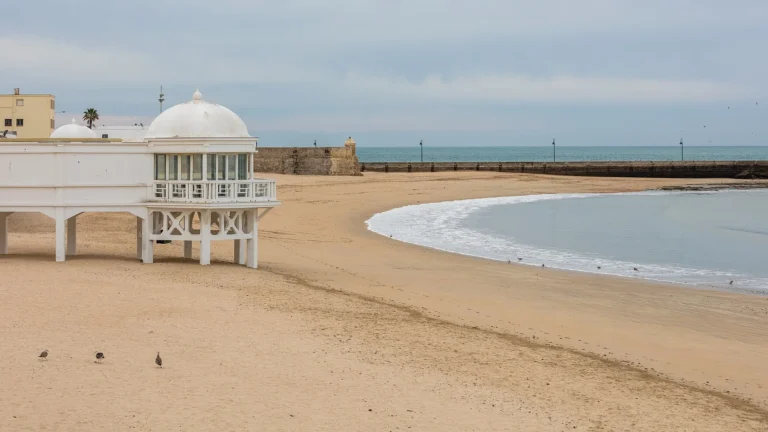
The beach is part of it. The bus to Punta Umbría takes 30 to 40 minutes, further west are El Portil and Islantilla, and to the east Mazagón and Matalascañas on the edge of Doñana. The article Beaches of the Costa de la Luz gives an overview. For weekends, Seville, Cádiz and Jerez are good options, plus the Algarve in Portugal. If you are there in spring, plan for Holy Week in Seville and the pilgrimage to El Rocío: see Festivals in Andalusia.
Getting there
You fly to Seville or to Faro in Portugal and continue by bus. Allow around an hour and a half, including the change. Book your journey so that you arrive during the day.
Paperwork: what you really need
For an exchange semester, the effort is small.
- Health insurance: compulsory for enrolment. The European Health Insurance Card (EHIC) is enough for the university. However, it only covers necessary treatment in the public system, so additional travel health insurance with repatriation makes sense.
- ID: ID card or passport, valid until after your return.
- NIE: For one semester you usually do not need the foreigner identification number. It becomes necessary if you work or if a landlord or bank asks for it. How it works is explained in Applying for an NIE.
- Bank account: Your account from home is enough. Bring a card without foreign transaction fees and some cash for the deposit.
Checklist before your flight
- Pre-registration in UMove completed, letter of acceptance saved
- Learning Agreement signed, with backup courses in mind
- EHIC and travel health insurance, each with a copy
- ID, copies and passport photos
- Grant Agreement with your home university signed
- Accommodation booked for the first few nights
- Signed up for the buddy programme
- Rain jacket and warm clothes for the winter: flats rarely have heating
You like the city so much that you want to do your whole degree there? Then read Studying in Huelva.
Frequently asked questions
Do I need a language certificate for Huelva?
No. The UHU does not require one, but recommends B2 in Spanish or English. Check whether your home university requires proof.
Can I take only English courses in Huelva?
That is uncertain. There is a list of subjects in English, but it is limited and depends on the faculty. Plan for at least some of your courses in Spanish.
When do I have to be in Huelva?
For the Welcome Week. In 2026/27 it ran from 7 to 11 September and from 18 to 22 January, and lectures started on 11 September and 25 January.
How much money do I need per month?
The university gives 450 to 500 euros as a guideline. With trips and going out, 570 to 915 euros is more realistic.
Is it easy to find a room?
Easier than in Seville or Málaga. Many people only start looking on site from temporary accommodation. Demand is highest at the beginning of September and in mid January.
Isn’t Huelva too small for a semester abroad?
That depends on you. For Spanish, the beach and a small budget, the city is ideal. If you want a big programme every week, you will be bored at weekends and often go to Seville.
Sources
- Universidad de Huelva: fact sheet for exchange students 2026/27
- Universidad de Huelva: Pre-Arrival, admission in three steps
- Universidad de Huelva: academic calendar Grado 2026/27
- Universidad de Huelva: accommodation guide
- Universidad de Huelva: buddy programme and university figures
- Idealista: rental price report Andalusia
As of: October 2026
Cover image: Calapito · Wikimedia Commons · CC BY-SA 3.0
Free
The moving checklist as a PDF (in German)
All steps in the right order to tick off. Plus the key tips by email over the next weeks (in German). Free, unsubscribe at any time.