In short: For a full degree at the Universidad de Granada you need the certificate from UNEDasiss for your Abitur or Matura and you apply in June through the central Andalusian procedure. The first year costs 757.20 euros, and after that almost nothing if you pass your exams at the first attempt (as of October 2026). Teaching is in Spanish, and you find your room yourself.
At a glance
- University: Universidad de Granada (UGR), founded in 1531, public
- Admission: UNEDasiss plus application via the Distrito Único Andaluz, in 2026 from 11 to 22 June
- Costs: 12.62 euros per ECTS for a Grado, from the second year a 99 percent discount on passed credits
- Language: Spanish, English courses only here and there
- Rent: 10.8 euros per square metre on average across the city (Idealista, September 2026)
- Who it suits: anyone looking for a large, old university in a manageable city and willing to study in Spanish
The Universidad de Granada: campuses and subjects
The Universidad de Granada (UGR) is one of the large public universities in Spain and, founded in 1531, one of the oldest. There is no single enclosed campus. Its more than 20 faculties and schools are spread across several locations in the city, and that shapes your daily life more than any brochure.
- Centro: historic buildings in the city centre, including law and translation.
- Cartuja: on the hill in the north, with humanities, psychology, pharmacy and economics.
- Fuentenueva: close to the centre, natural sciences and civil engineering.
- Aynadamar: computer science and telecommunications, plus fine arts.
- Ciencias de la Salud (PTS): the health campus in the south with medicine and the health subjects.
There are also locations in Ceuta and Melilla on the North African coast. Pay attention to this when applying: some degrees exist twice, once in Granada and once there, and each location is a separate entry on your list of choices.
The range of subjects is broad, from medicine and computer science to translation and interpreting, a subject Granada is known for in Spain. The university shows on its website which faculty is where. Check this before you look for a room: half the city lies between Cartuja and the PTS.
Language of instruction
Teaching is in Spanish. The economics faculty itself states that practically all courses are held in Spanish, with a few in English. At the Faculty of Arts, almost all the English courses belong to English studies. You should not plan on a complete degree in English here. From experience we know: lectures, group work, exams and every email from the secretariat are in Spanish.
We have not found a confirmed fixed rule on a Spanish certificate for admission to a Grado in Andalusia. In practice you need a solid B2 to pass exams. There is also a special requirement: to complete a Grado in Andalusia you must prove a foreign language at B1. This applies to all students. Which certificates the UGR accepts if German is your native language is something to clarify with your faculty’s secretariat.
Admission with Abitur or Matura
You do not apply to the UGR itself. Places are allocated by the Distrito Único Andaluz, the joint procedure of all public universities in Andalusia. As a German or Austrian, you are in the general quota there and compete with Spanish school leavers for the same places.
-
Apply for the Acreditación at UNEDasiss
UNEDasiss is the office of the distance university UNED that converts school qualifications from EU countries into the Spanish system. With Abitur or Matura you do not need a Homologación (formal recognition by the ministry). In 2026 you could apply from 4 February to 1 December. The application is only processed after payment.
-
Decide whether you need PCE exams
Your converted grade goes up to a maximum of 10 points. The nota de admisión (admission grade) goes up to 14: you get the missing 4 points through up to two weighted subject exams, the PCE. The ordinary round in 2026 took place in Spain from 25 to 29 May, and at the exam centres in the rest of Europe from 8 to 13 June.
-
Online application in June
In 2026 the ordinary phase ran from 11 to 22 June. You submit a single application and rank as many degrees in it as you like. The order is binding.
-
Wait for the allocation and react immediately
The first allocation came on 3 July 2026, the second on 16 July, followed by further rounds until October. After each list you only have a few days to enrol or reserve your place.
The nota de corte (the grade of the last admitted applicant) is set anew each year by supply and demand. In Granada the health subjects are traditionally at the top, with medicine the highest. We do not give specific values here, because only the official list from the previous year counts. The UGR links to it on its application page, and the relevant column is “Cupo General”. The dates for 2027/28 had not yet been published in October 2026. Everything else about UNEDasiss, PCE and how grades work is in the main guide Studying in Spain.
What studying costs
Prices are set by the regional government for all public universities in Andalusia. They have not changed since 2023/24.
| Item | Amount |
|---|---|
| Grado, first enrolment | 12.62 euros per ECTS, 757.20 euros for 60 ECTS |
| Grado, second enrolment in the same subject | 25.25 euros per ECTS |
| Máster (not professionally qualifying) | 13.68 euros per ECTS, 820.80 euros for 60 ECTS |
| Opening your file | 59.10 euros |
| Student card | 5.70 euros |
The biggest lever is the Bonificación del 99 %: Andalusia waives 99 percent of the costs for all credits you passed at the first attempt in the previous year. So you pay the first year in full, and almost nothing after that. The Junta does not mention any income limit or nationality requirement. You must submit a declaration when you enrol. Failed subjects cost twice as much.
From Germany you can get Auslands-BAföG (German state student funding for study abroad) for the whole degree, including a supplement for tuition fees in the first year. The office responsible for Spain is the Studierendenwerk Heidelberg, and you should send your application about six months in advance. In Austria there is the Mobilitätsstipendium (mobility grant) for a complete degree in the EEA.
Enrolment on site: the matrícula
You complete the matrícula (enrolment with choice of subjects) online after the allocation, and the secretariat of your faculty then checks the documents. The admission notice states which documents are required as originals. Expect to need:
- ID card or passport
- the Acreditación from UNEDasiss
- Abitur or Matura certificate
- an IBAN if you want to pay in instalments (in one payment, in 2 or in up to 8 instalments)
- the signed declaration for the 99 percent discount from the second year
When you enrol, you get the TUI (Tarjeta Universitaria Inteligente), your student card.
Living for several years
For a city this famous, Granada is affordable. For September 2026, Idealista lists an asking price of 10.8 euros per square metre for entire flats, which works out at around 756 euros for 70 square metres. Málaga is at 16.5 euros, Seville at 13.4 euros. The reports give no confirmed average price for rooms in shared flats in Granada.
Neighbourhoods for students
- Centro and Realejo: everything within walking distance, lots of bars, older buildings, often without a lift.
- Camino de Ronda and Plaza de Toros: blocks of flats from the seventies, practical, lots of shared flats, close to Fuentenueva and the metro.
- Cartuja and surroundings: cheaper, a good idea if your faculty is on the hill.
- Albaicín: beautiful, but steep, winding and cold in winter. Tiring for everyday life with shopping.
- Zaidín and the area around the PTS: residential neighbourhoods in the south, the obvious choice for medicine and health subjects.
Shared flat, your own flat or Colegio Mayor
Most students live in shared flats. If you stay for several years, you are better off with a normal residential tenancy contract than with contracts that end every summer: many landlords only rent from September to June. Ask about this before you sign. Details on contracts and deposits are under Finding a flat in Spain.
An alternative for the first year are the colegios mayores, halls of residence with meals and their own community life. The UGR lists ten halls it has an agreement with, including Isabel la Católica, Cardenal Cisneros and San Bartolomé y Santiago. They are considerably more expensive than a room in a shared flat, and prices and applications are handled by each hall. The university’s housing portal collects private room offers.
Monthly budget
The table is an estimate for life in a shared flat, not statistics. Only the transport prices and the comparison figure below are confirmed.
| Item | Estimated range per month |
|---|---|
| Room in a shared flat including bills | 300 to 450 euros |
| Groceries | 180 to 250 euros |
| Bus and metro | 0 to 25 euros |
| Mobile phone | 5 to 15 euros |
| Leisure, tapas, trips | 100 to 200 euros |
| Total | around 600 to 950 euros |
For context: the statistics office INE reports average spending in Andalusia of 1,016 euros per person per month (2025), although this includes all age groups and imputed rents for owners. More on this under Cost of living in Spain.
Working alongside your studies
As an EU citizen you may work in Spain without a permit. You need an NIE and a social security number to do so. Typical jobs are in hospitality, tutoring in German or English, and customer service in your native language, often remote. Wages in Granada are low, and in hospitality shifts often clash with afternoon lectures. Plan your budget so that you do not depend on the job. The routes into the job market are explained in Working in Spain.
Transport: on foot, by bus and metro
Granada is compact, and you can walk to a lot of places. A single city bus ride costs 1.60 euros, the monthly pass 24.60 euros (as of July 2026). The metro, a light rail line from Albolote to Armilla, stops at Fuentenueva and the PTS, among other places. A single ride costs 1.35 euros, or 0.49 euros with a rechargeable card (as of August 2026). If you are under 30, you can apply for the Junta’s Tarjeta Joven de Transporte: according to the UGR, it gives up to 50 percent off on the metro, city and intercity buses. Cycling is possible, but the hills in the north and east make it a workout.
Life in Granada, with the honest downside
Students shape the city, and you notice it in the prices. Bars traditionally serve a tapa with your drink, see Tapas in Granada. In winter you can be at the ski resort of the Sierra Nevada in under an hour, and from May on the Costa Tropical. For weekends over several years, the list of day trips from Granada is worth a look.
The downsides are part of it. Granada has no sea and a harsh climate: very hot summers, cold winter nights, and many flats have no central heating. The job market is weak. If you want to stay in the city after graduating, finding a job is harder than in Málaga or Seville. And the airport is small, so most flights home go via Málaga.
Paperwork for a degree lasting several years
With a full degree, you live in Spain rather than just visiting. You should take care of these things in your first semester:
- NIE: the foreigner identification number. You need it for an employment contract, many rental contracts and dealing with the authorities. Guide: Applying for an NIE.
- Padrón: registration at the town hall. Among other things, it is a requirement for the cheaper bus fare for young people living in Granada. Guide: Empadronamiento.
- Bank account: a German or Austrian IBAN is legally sufficient for direct debits, but a Spanish account with Bizum makes everyday life in a shared flat easier. See Opening a bank account.
- Health insurance: the European Health Insurance Card (EHIC) covers necessary treatment in the public system. Before you move, check with your insurer how you stay covered during several years of study abroad. Background: Health insurance in Spain.
Only coming for one or two semesters? Then read Erasmus in Granada.
Frequently asked questions
Can I study medicine in Granada with a German Abitur?
In principle yes, but the hurdle is high. You need the Acreditación from UNEDasiss and practically always two very good PCE exams, because the admission grade for medicine is far above the 10 points you can reach without PCE. The current nota de corte is in the UGR’s official list.
Do I need a Spanish certificate to apply?
We have not found a confirmed fixed requirement for admission to a Grado in Andalusia. But without a reliable B2 you will hardly be able to follow the exams. If in doubt, ask the UGR’s admissions service.
How much does a full Grado in Granada cost?
The first year with 60 ECTS costs 757.20 euros plus small administrative fees. If you pass everything at the first attempt, the 99 percent discount means you only pay a fraction in the following years (as of October 2026).
When should I start planning?
About a year in advance. You apply for the Acreditación from February, PCE registration in 2026 ran from February to April, and the application is in June. If you only start in summer, you end up in the rounds for remaining places.
Does the university have a hall of residence?
There are colegios mayores with an agreement with the UGR that offer places with meals and cost considerably more than a shared flat. The usual option is a room in a shared flat that you find yourself.
Can I get a Spanish grant as a German?
The state beca from the Ministry of Education is subject to conditions for EU citizens, for example that you or your parents work in Spain. Auslands-BAföG or the Austrian Mobilitätsstipendium are easier options.
Sources
- Universidad de Granada: Grado application 2026/27
- Universidad de Granada: Notes on the notas de corte
- UNEDasiss: Dates 2026
- Junta de Andalucía: Guide to the 99 percent discount
- Universidad de Granada: Colegios Mayores
- Idealista: Andalusia rental price report
As of: October 2026
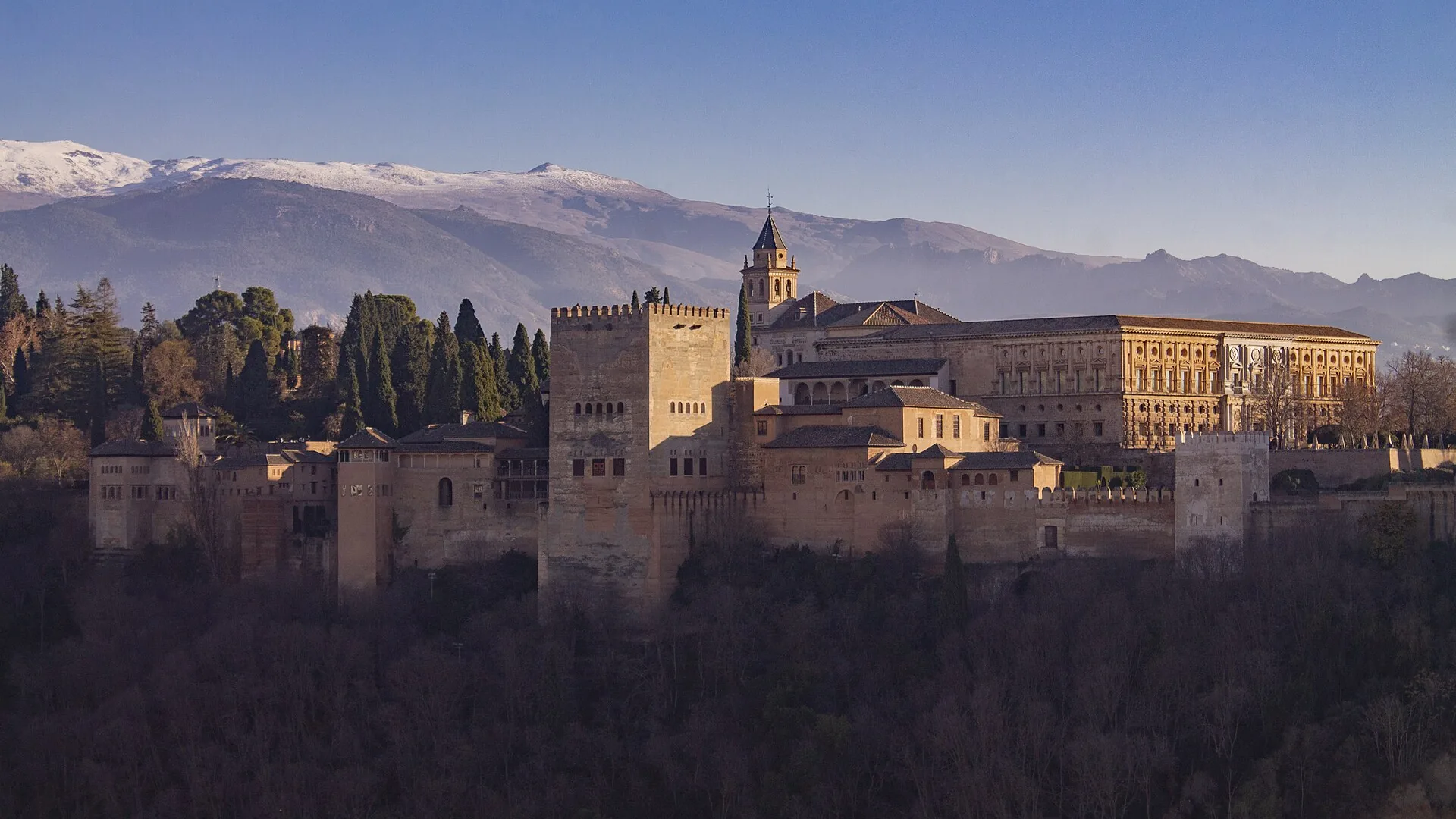
Cover image: Dionisioortiz · Wikimedia Commons · CC BY 4.0
Free
The moving checklist as a PDF (in German)
All steps in the right order to tick off. Plus the key tips by email over the next weeks (in German). Free, unsubscribe at any time.