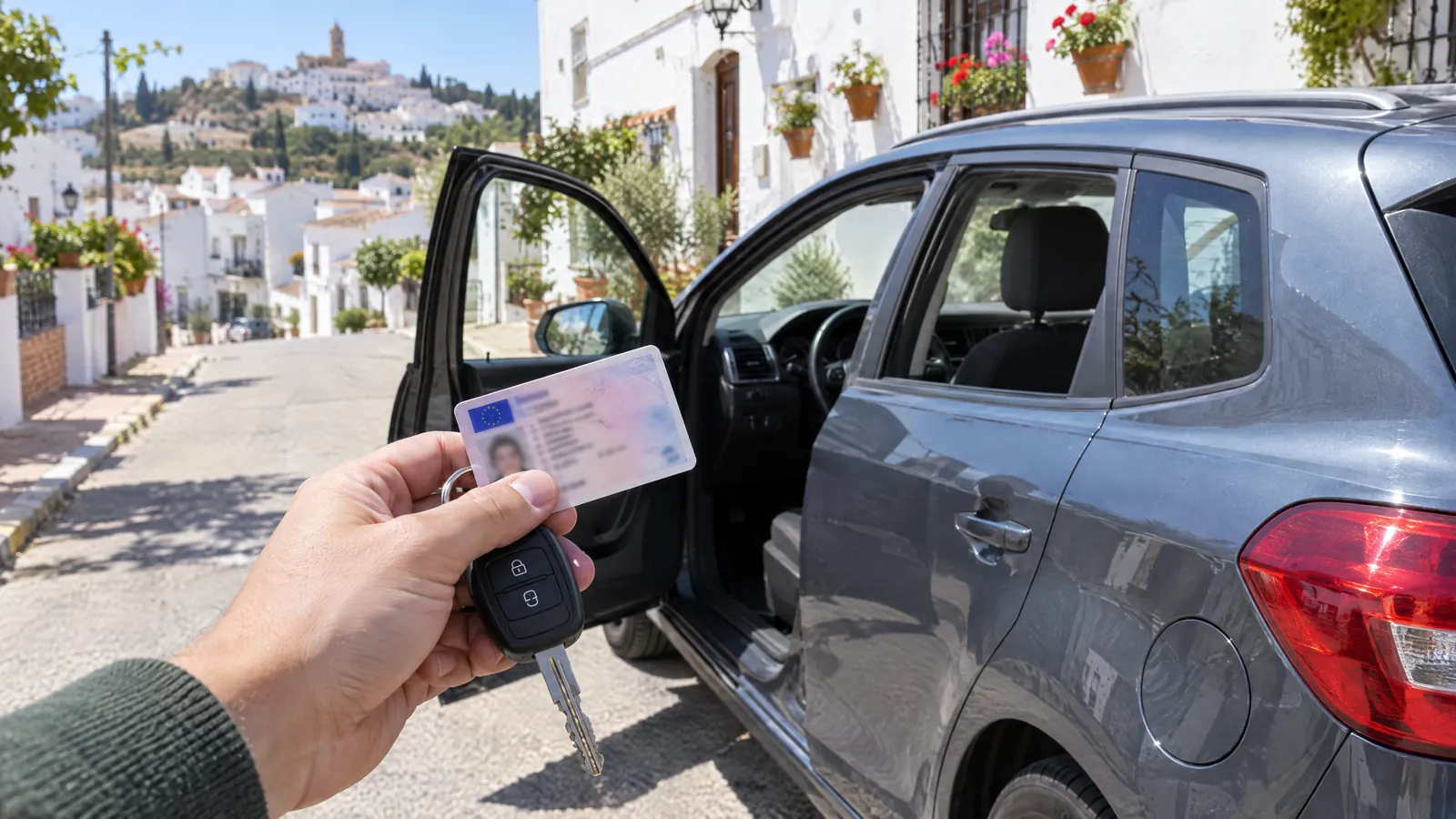
In short: If you move to Spain, you have to re-register your car: for the tax exemption when moving you have 60 days, otherwise 30 days apply. Registration with the traffic authority DGT costs 99.77 €, plus the technical inspection, number plates and vehicle tax. Your driving licence from Germany or Austria remains valid; old licences without an expiry date have to be renewed two years after the move.
At a glance
- Re-registration deadline: 30 days from first use in Spain, 60 days when moving your residence with a tax exemption
- Registration fee: 99.77 € (DGT), change of owner 55.70 €
- Registration tax: exempt under certain conditions when moving, application to the Agencia Tributaria
- Driving licence: remains valid; renewal 24.58 €, free from age 70
- Where: ITV station, Agencia Tributaria, town hall, Jefatura de Tráfico (DGT)
- What you need: original vehicle documents, CoC, NIE, Padrón
Do you actually have to re-register your car?
Yes. If you move your residence to Spain, you may not drive permanently with German or Austrian number plates. The Spanish administration sets two deadlines: 30 days from the start of use in Spain, and 60 days if you move your residence and meet the conditions for the tax exemption.
Whether re-registering is worth it is a matter of doing the maths. For a newer car you’ve owned for years, usually yes. For an old car of low value, inspection, paperwork and fees can be out of proportion; then selling it before the move is often easier. Insurance plays a role too: your current policy usually won’t cover a car kept permanently in Spain in the long run.
Re-registering your car: the five steps
The DGT sets the process. The order matters, because each office wants to see proof from the previous one.
-
Gather the documents
You need the original vehicle documents, proof of ownership (purchase contract with translation, or invoice) and the EU Certificate of Conformity (CoC). If the CoC is missing, order it from the manufacturer. On top of that you need your NIE and the Padrón (registration at the town hall) as proof of residence.
-
Technical inspection at the ITV
The ITV (Inspección Técnica de Vehículos) is the Spanish roadworthiness test. For an imported vehicle the station issues a Spanish technical card (Tarjeta ITV). You present the original registration and proof of type approval, i.e. the CoC. For vehicles from before 2002 you need an individual technical document instead (ficha reducida), prepared by an engineering office.
-
Sort out the taxes
Three taxes play a role: the registration tax (Impuesto de Matriculación, Modelo 576, or Modelo 06 or 05 for an exemption) at the Agencia Tributaria, the municipal vehicle tax (IVTM) at the town hall, and proof of VAT or transfer tax, which only applies to new vehicles or a recent used purchase.
-
Apply for registration at the DGT
With the ITV card, tax receipts and ID, you apply for registration online or with an appointment at the Jefatura de Tráfico in your province. The fee is 99.77 €. You receive the Spanish vehicle registration certificate (permiso de circulación) and your plate number.
-
Have the number plates made
The plates are made by an authorised manufacturer, often a shop near the authority or a car parts dealer. Then you take out Spanish insurance on the new plate or switch your existing policy.
If registration takes longer, there are temporary green plates (placas verdes). They are valid for two months, can be extended and require insurance.
Registration tax: how to save it when you move
The registration tax is based on the car’s CO2 emissions and its official current value. If you move to Spain, you can be exempt from it (Art. 66.1 n of Ley 38/1992). The legal conditions:
- Your habitual residence was outside Spain for at least 12 months before the move.
- You acquired or used the vehicle at least 6 months before the move.
- You submit the application within 60 days from the start of use in Spain.
- You don’t sell the car in the 12 months after registration.
You submit the application to the Agencia Tributaria. The deadlines run from the move, not from the day you have time.
How much does re-registration cost?
Only the state fees are fixed. They come from the Ministry of the Interior’s list of fees (retrieved in October 2026); check before paying whether they have been adjusted.
| Fee (DGT tasa) | Amount |
|---|---|
| Registration of a vehicle (1.1) | 99.77 € |
| Registration of a moped (1.2) | 27.85 € |
| Change of owner (1.5) | 55.70 € |
| Information or vehicle report (4.1) | 8.67 € |
| Renewing a driving licence (4.3) | 24.58 € |
| Duplicate driving licence (4.4) | 20.81 € |
| Driving licence exchange without a test (2.3) | 28.87 € |
On top of that come items whose amount depends on the station, the municipality and the car: the import inspection at the ITV, the ficha reducida if needed, the number plates, the pro rata vehicle tax of your municipality and, if you hand over the paperwork, the fee of a Gestoría (administrative agency). Ask for the prices in advance.
For the later regular ITV, fixed tariffs from the operator VEIASA apply in Andalusia (including 21 % IVA): cars under 1,600 cm³ cost 33.28 € (petrol) or 38.39 € (diesel), from 1,600 cm³ 43.52 € or 48.62 €, electric cars 29.11 €. How often you have to go depends on the age of the vehicle; the next date is on the ITV card and on the sticker on the windscreen.
Canary Islands: import with a customs declaration
The Canary Islands belong to the EU, but not to the EU VAT area. A car from Germany or Austria is therefore imported there with a customs declaration (DUA), and the island tax IGIC applies instead of VAT. Whether and under what conditions your car is exempt from import duties as household goods, clarify before shipping with the Canary Islands tax administration (Agencia Tributaria Canaria) or a customs agent. Also factor in the ferry from Cádiz or Huelva. For older cars, buying on the island is often the simpler solution. More on the islands’ tax system under IGIC in the Canary Islands.
Buying a car in Spain
If you buy from a dealer, they handle the registration and the tax is included in the price. If you buy privately, you have to act yourself:
- Before buying: get the DGT vehicle report (informe del vehículo, 8.67 €). It shows the owner, any charges and whether the ITV is valid.
- Tax: a private used car purchase is subject to the transfer tax ITP. In Andalusia this is 4 %, 8 % for vehicles over 15 fiscal horsepower and 1 % for zero-emission vehicles. In the Canary Islands, separate rates of the Canary Islands tax administration apply.
- Change of owner: you register the car in your name at the DGT (55.70 €). Do this promptly after the purchase, together with the tax receipt.
- Insurance: third-party liability is compulsory and must be in place from the day of handover.
For the purchase and change of owner you need your NIE, Padrón and, in practice, a Spanish bank account too.
Driving licence: what applies to you
The DGT rules for licences from the EU and EEA are simpler than many forums claim.
- Your driving licence is valid in Spain as long as it is valid.
- Registering it with the DGT is voluntary, and so is exchanging it for a Spanish licence (canje).
- If your licence expires, you renew it in Spain, because you live here. You can apply from three months before expiry without losing validity.
- If it is lost, stolen or damaged, you receive a Spanish licence as a replacement.
The two-year rule
Renewal becomes compulsory two years after your habitual residence in Spain begins, if your licence has no expiry date or is valid for more than 15 years (categories AM, A1, A2, A, B, BE) or more than 5 years (categories C and D). This affects the old German paper licences, card licences without an expiry date and old Austrian licences without an expiry date. You then receive a Spanish driving licence.
How renewal works
You need the application form (Modelo 03), ID card or passport, your current licence, proof of the fee payment and a medical fitness report (informe de aptitud psicofísica) from an approved Centro de Reconocimiento de Conductores. These centres exist in every city; the test takes a few minutes and costs extra. You submit the application in person with an appointment (cita previa) at the Jefatura de Tráfico. The fee is 24.58 €, and from age 70 renewal is free. The original is retained, you receive a provisional driving permit for six months, and the new licence arrives by post after about a month and a half.
Frequently asked questions
How long can I drive in Spain with German number plates?
As a holidaymaker, no problem. As soon as you live in Spain, the deadline of 30 days from use applies, or 60 days when moving your residence with a tax exemption.
Do I need a Gestoría for re-registration?
No, you can do all the steps yourself. A Gestoría saves you trips and waiting time, because it submits the applications to the tax authority and the DGT in one go.
What happens if my car has no CoC?
Then you order it from the manufacturer. For vehicles from before 2002, an engineering office prepares a ficha reducida, which the ITV accepts instead of the CoC.
Do I have to exchange my driving licence straight away?
No. A valid driving licence from Germany or Austria remains valid. Renewal only becomes compulsory when it expires or, for licences without an expiry date or with very long validity, two years after the move.
Can I sell my car right after re-registering it?
Not if you used the registration tax exemption: the car may not be sold in the 12 months after registration.
Sources
- DGT: registering a vehicle from the EU
- administracion.gob.es: registration tax and deadlines when moving
- Ministry of the Interior: traffic authority fees
- DGT: driving licences from the EU and EEA
- VEIASA: ITV tariffs in Andalusia
- Junta de Andalucía: transfer tax rates
Last updated: October 2026
Rather do it yourself?
Playbook: Re-registering your car
Your car from Germany or Austria with Spanish plates: deadlines, tax exemption, ITV, DGT appointment, the Canary Islands and all costs. 20 pages, PDF in German.
Free
The moving checklist as a PDF (in German)
All steps in the right order to tick off. Plus the key tips by email over the next weeks (in German). Free, unsubscribe at any time.