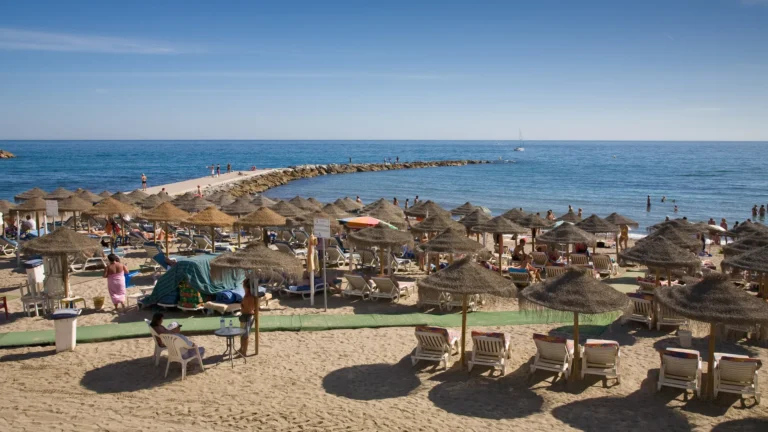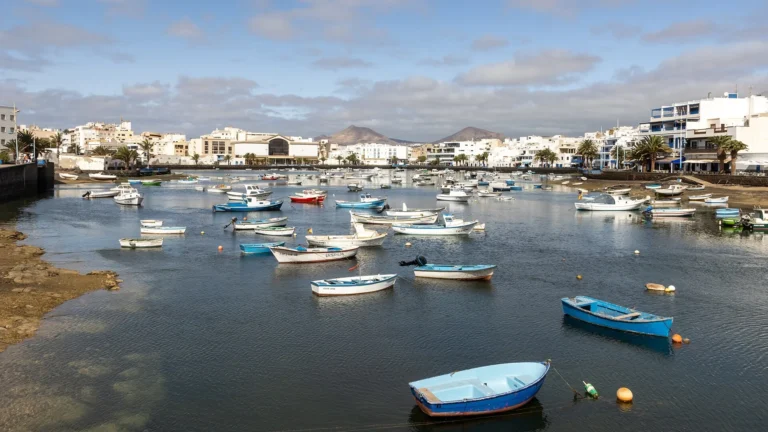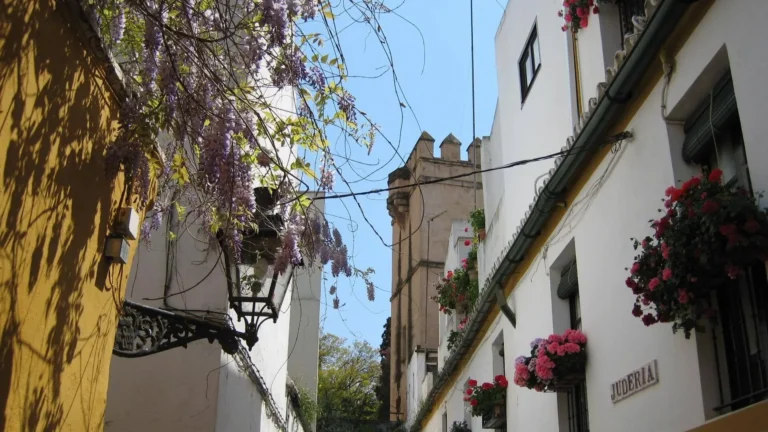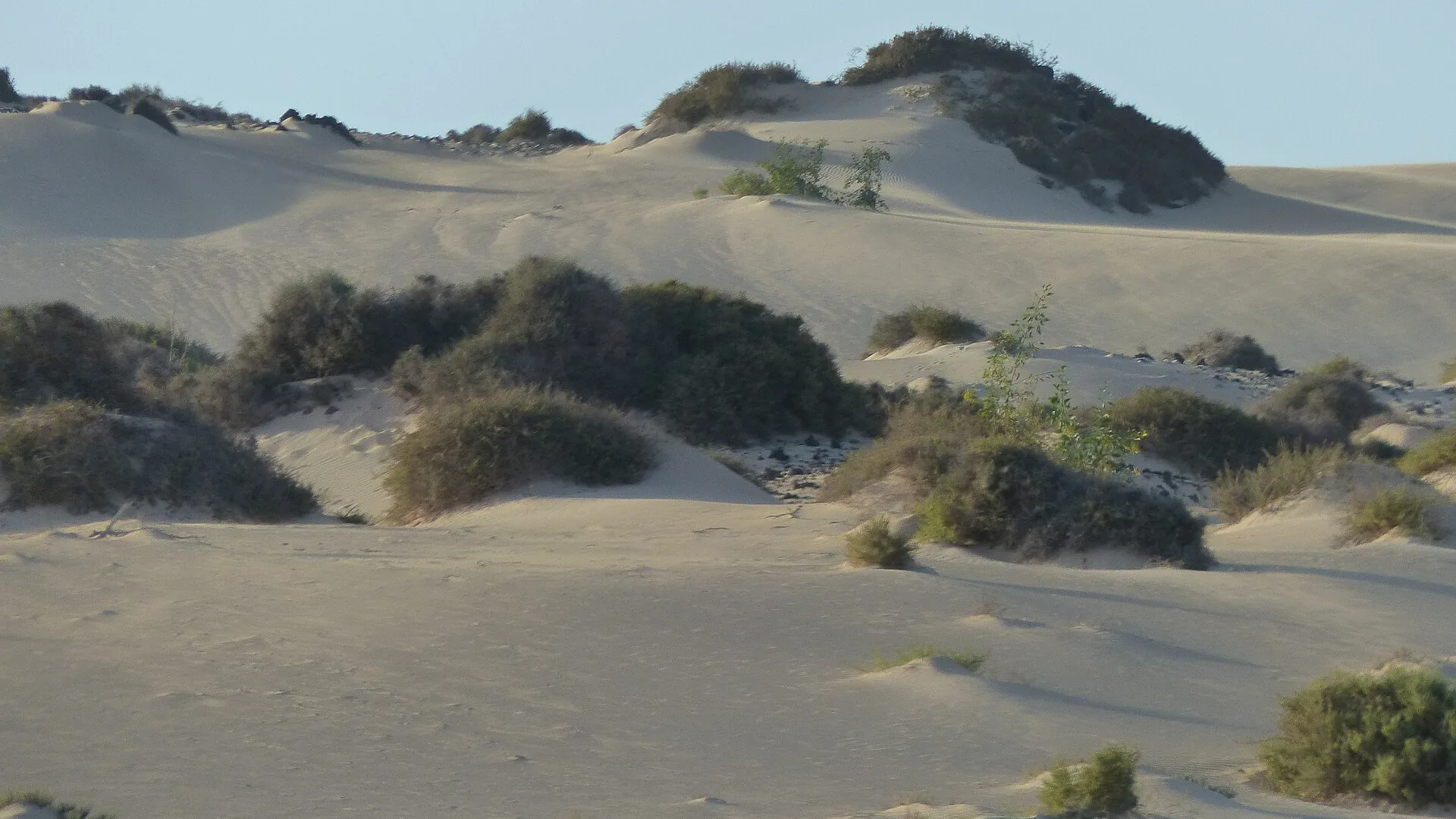
In short: Fuerteventura is worth it for you if you love open space, beaches and wind and bring your own income. A 70 m² flat works out at around 860 € in Puerto del Rosario and around 1,320 € in La Oliva with Corralejo. To be honest: the island is sparsely populated, the only public hospital is in the capital, and work is almost exclusively in tourism.
At a glance
- Population: 129,080, of whom 46,150 live in Puerto del Rosario (INE, 2025)
- Rent: Puerto del Rosario 12.3 €/m², La Oliva 18.8 €/m² (Idealista, September 2026)
- Climate: in January an average of 20.6 °C during the day, in August 27.8 °C, 98 mm of rain a year (AEMET)
- Unemployment: 12.4 % in the province of Las Palmas (EPA, Q2 2026)
- Hospital: Hospital General de Fuerteventura in Puerto del Rosario
- Who it suits: remote workers, retirees in good health, water sports fans, self-employed people
Who is Fuerteventura right for, and who not?
Fuerteventura is the second largest Canary Island, but one of the most sparsely populated. Around 100 kilometres long, with long sandy beaches, dunes and lots of empty land. Since 2009 the whole island has been a UNESCO Biosphere Reserve. People who live here are usually looking for exactly that: space, sea and little hustle.
The island suits you well if you:
- work remotely or bring a pension or other steady income.
- want to make surfing, kitesurfing, windsurfing or diving part of your everyday life.
- find peace and nature more important than culture, shopping and nightlife.
- can live with longer journeys to doctors, public offices and shops.
Fuerteventura is less of a fit if you are looking for a city with cultural life, regularly need specialists or depend on a well paid local job. The wind is not for everyone either: what surfers love gets on other people’s nerves in the long run. Families with teenagers should look closely at the school question.
German-speaking doctors in Fuerteventura: 5 verified practices and clinics →
Living on Fuerteventura as a German: what is different?
As a German or Austrian you need no visa and no work permit for Spain. Still, the move is more than a long holiday. The island is international: according to the statistics office ISTAC, almost 40 % of residents were born outside Spain, and in the municipality of La Oliva with Corralejo it is even more than half (as of January 2024).
German-speaking environment
In the south around Costa Calma and Morro Jable, on the Jandía peninsula, many hotels have catered to guests from Germany for decades. There you will find German-speaking restaurants, estate agents and service providers. That makes the start easier, but it can turn into a bubble. In the north around Corralejo the crowd is more mixed, with many Italians, Brits and surfers from all over Europe.
Public offices, language and pace
Public offices, health centres and landlords speak Spanish. Appointments at public offices are scarce, processes take longer than in Germany, and a lot only works online with the digital certificate. If you learn Spanish, you will settle in much faster. How everyday life in Spain works is described in Everyday life in Spain.
What you need before the move
- A valid ID card or passport
- NIE (foreigner identification number), see Applying for the NIE
- A regular rental contract for registering at the town hall
- Health insurance for the time before you are in the public system
- Savings for the deposit, furniture, a car and the first few months
- The Abmeldung (deregistration) in Germany or Austria
Where to live on Fuerteventura? The towns compared
The island is long and narrow. Where you live determines your everyday life, because driving from the north to the south takes well over an hour. The prices come from the Idealista reports for September 2026 and are asking prices.
| Municipality (towns) | Rent €/m² | Purchase €/m² |
|---|---|---|
| Puerto del Rosario | 12.3 | 2,200 |
| La Oliva (Corralejo, El Cotillo) | 18.8 | 3,697 |
| Antigua (Caleta de Fuste) | no value | 3,115 |
| Pájara (Costa Calma, Morro Jable) | no value | 3,494 |
Puerto del Rosario
The capital is not a postcard town, but it is the most practical place to live: the hospital, public offices, schools, large supermarkets and the airport are all nearby. More than a third of the island’s population lives here, and this is where rents are lowest. If you want to work or send children to school, you are in good hands here.
Corralejo
The town in the north is the hub for surfers, kitesurfers and remote workers, with dunes on the doorstep and the ferry to Lanzarote. Corralejo is lively, international and expensive: at 18.8 €/m², La Oliva has the highest documented rent on the island. A 70 m² flat therefore works out at around 1,316 €.
El Cotillo
The small fishing village on the west coast is quieter than Corralejo and popular with surfers and families. The choice of shops and flats is small. In August 2025, after a pipe failure, El Cotillo went without a full water supply for days, an example of how fragile the infrastructure in the north is.
Costa Calma
The holiday resort in the south lies on long, pale beaches and caters heavily to German guests. In summer it is often especially windy there. Costa Calma is popular with retirees looking for peace and German in everyday life. It is a long way to the hospital in Puerto del Rosario, though.
Morro Jable
The southernmost town has a port with ferries to Gran Canaria, an established town centre and a long beach. Morro Jable is a real town with locals, not just a hotel location. The distance to the capital is its biggest drawback.
What does life on Fuerteventura cost?
Costs depend almost entirely on where you live. According to the INE, a person in the Canary Islands spends an average of 1,054 € a month (2025 data). The following table separates documented values from our own estimates.
| Item | Amount per month | Basis |
|---|---|---|
| Rent 70 m², Puerto del Rosario | around 861 € | Idealista 12.3 €/m², September 2026, extrapolated |
| Rent 70 m², La Oliva (Corralejo) | around 1,316 € | Idealista 18.8 €/m², September 2026, extrapolated |
| Electricity and water | 60 to 120 € | estimate, strongly depends on usage |
| Internet and mobile | 25 to 50 € | estimate |
| Groceries, 1 person | 250 to 400 € | estimate |
| Car (insurance, petrol) | 120 to 250 € | estimate; in June 2026 Super 95 cost an average of 1.441 €/l in the Canary Islands (CNMC) |
A person living alone realistically comes to 1,400 to 1,800 € a month in Puerto del Rosario, and more like 1,800 to 2,300 € in Corralejo (our own estimate from the values above). Petrol, mobile phone plans and eating out are cheap. Instead of 21 % VAT, the IGIC (island tax) applies with a general rate of 7 %. Many goods that arrive by ship, furniture and spare parts are more expensive. More figures and a calculator are in Cost of living in Spain, and tips for the search in Finding a flat in Spain.
Work and self-employment on Fuerteventura
The job market is small and heavily dependent on tourism. Unemployment in the province of Las Palmas was 12.4 % in the second quarter of 2026, compared with 9.87 % in Spain as a whole (EPA).
Working as an employee
Jobs are mainly in hotels, hospitality, tour operators, car rentals, surf and diving schools and estate agencies. In the south, hotels for German guests regularly look for German-speaking staff, but Spanish is almost always expected. Wages are far below German levels, and many contracts are seasonal. An overview of the options is in Working in Spain.
Remote and self-employed
The most stable way to live on Fuerteventura is with income from outside. Fibre is widespread in the towns; in remote houses you should check the connection before renting. As a self-employed person you register as Autónomo. In the Canary Islands you pay IGIC instead of VAT, and since 1 July 2026 you can use the REPEP small business scheme for turnover up to 50,000 €. Everything about it: Self-employed in the Canary Islands. If you work remotely for an employer abroad, read Moving to Spain as a digital nomad.
Moving to Fuerteventura as a retiree or with children
The peace and the climate attract many retirees, while families are drawn by life by the sea. Both groups should check the infrastructure carefully.
As a retiree
Your pension from Germany or Austria continues to be paid to Spain. You are covered for health through the form S1 from your health insurance fund, which you present to the INSS (Spanish social security). From more than 183 days a year you are liable to pay tax in Spain, see Taxes in Spain. Important for choosing where to live: the older you get, the more being close to the hospital in Puerto del Rosario matters. Everything about pensions and the S1: Retiring to Spain.
With children
On Fuerteventura, children attend Spanish public or private schools. There is no German school abroad recognised by Germany on the island; according to the Kultusministerkonferenz (the conference of German education ministers), the nearest ones are in Las Palmas de Gran Canaria and Santa Cruz de Tenerife. Young children learn Spanish quickly, while for teenagers the start is harder. Leisure options beyond the beach and sports are limited. More on this: Moving with your family.
Health and health insurance: an honest look
Public healthcare is provided by the Servicio Canario de la Salud (SCS). There are GPs in the municipal health centres, and the only public hospital on the island is the Hospital General de Fuerteventura in Puerto del Rosario. For some examinations and treatments it refers patients to clinics on other islands; for this the SCS issues flight or ferry vouchers.
Since March 2026, Fuerteventura has had its own rescue helicopter from the SUC emergency service. Especially from the south around Jandía, this shortens the journey to hospital in emergencies. For people with chronic illnesses, island life is still a real drawback: plan specialist appointments with travel time included.
You get into the public system through a job, as an Autónomo or as a retiree with an S1. If you have none of these, you first need private health insurance. After one year in Spain and with a Padrón in the Canary Islands, the Convenio especial is available for 60 € a month under 65 and 157 € from age 65 (as of October 2026), without medication. More on this: Health insurance in Spain.
Climate, water and getting around
The weather is almost always good, the infrastructure not always. Both belong in an honest calculation.
Climate through the year
The AEMET values from the airport (averages 1981 to 2010) show hardly any seasons:
| Month | Daytime | Night | Rain |
|---|---|---|---|
| January | 20.6 °C | 14.7 °C | 14 mm |
| April | 22.9 °C | 16.0 °C | 5 mm |
| August | 27.8 °C | 21.5 °C | 0 mm |
| October | 26.1 °C | 19.8 °C | 8 mm |
There are 98 mm of rain a year and around 2,836 hours of sunshine. The trade wind cools things down in summer, but it can blow hard for days. More: Canary Islands weather.
Water and electricity
Drinking water on Fuerteventura comes almost entirely from seawater desalination and is distributed through long pipelines. In the north there have been repeated outages after pipe bursts in recent years, for example in August 2025 in Lajares, Villaverde and El Cotillo. That is why many houses have their own water tank. Ask about it when renting.
Car, bus, ferry and flights
Life on Fuerteventura is hardly possible without a car. Buses connect the main towns but run infrequently. For frequent travellers resident in the Canary Islands, the bus is free in 2026. The ferry from Corralejo to Playa Blanca on Lanzarote takes 25 to 35 minutes, the ferry from Morro Jable to Gran Canaria around two hours. The airport is near Puerto del Rosario, with direct flights to Germany, much more frequent in winter than in summer. With a Padrón in the Canary Islands you get a 75 % resident discount on flights and ferries within Spain. About bringing your car from Germany: Re-registering your car and driving licence.
Parcels from Germany
The Canary Islands are outside the EU VAT area. Parcels go through customs, IGIC and courier fees are often charged, and many online shops do not deliver at all. Anything you definitely need is better brought with you in the move.
First steps after arriving on Fuerteventura
The right order saves you trips, and on Fuerteventura the trips are long.
-
Apply for the NIE
Ideally before the move. On the island, the police station in Puerto del Rosario is responsible. Guide: Applying for the NIE.
-
Rent a flat with a regular contract
A holiday rental contract is usually not enough for registration.
-
Padrón at the town hall
Registration in your municipality: Puerto del Rosario, La Oliva, Pájara, Antigua, Tuineje or Betancuria. See Applying for the Padrón.
-
Open a bank account
For rent, electricity and direct debits: Opening a bank account in Spain.
-
Health insurance and health card
Through a job, Autónomo, S1 or private; then the card from the SCS.
-
Set up electricity, internet, mobile
Here is how: Setting up mobile, internet and electricity.
Help with moving to Fuerteventura
deinSpanien supports you in English or German with your move to Andalusia and the Canary Islands, online and therefore on Fuerteventura too. We book appointments, fill in forms and handle steps for you with a power of attorney. We live in Spain ourselves and have gone through each of these bureaucratic steps ourselves. What we take care of is under Advice and packages.
Experiences and typical mistakes on Fuerteventura
Many people who move to the island report the same surprises. You can head off most of them in advance:
- Only tested on holiday: Spend a few months on the island before the move, ideally also in the windy summer. A good trial run is wintering in the Canary Islands.
- Chose where to live based on a favourite beach: If you live in the south and work in Puerto del Rosario or need to see a doctor there, you spend a lot of time in the car.
- Counted on a local job: Without Spanish and with low wages, that is often not enough for Corralejo rents.
- Underestimated health: If you regularly need specialists, check distances and waiting times beforehand.
- Living only in the German bubble: Comfortable at first, lonely and dependent in the long run.
- Put off the paperwork: No Padrón, no resident discount; no insurance, no GP.
Still undecided? Compare Fuerteventura with Lanzarote, Gran Canaria and Tenerife or read the overview Moving to the Canary Islands. The most beautiful beaches on the island: Fuerteventura beaches.
Frequently asked questions
How much does life on Fuerteventura cost per month?
Rent for 70 m² works out at around 861 € in Puerto del Rosario and around 1,316 € in La Oliva (Idealista, September 2026). With utilities, food and a car, one person comes to 1,400 to 2,300 € a month by our estimate.
What do I need to consider as a German moving to Fuerteventura?
You do not need a visa. Take care of the NIE, a regular rental contract, the Padrón, health insurance and the Abmeldung (deregistration) in Germany. Learn Spanish, because public offices and doctors work in Spanish.
How good is healthcare on Fuerteventura?
For basic care there are health centres in the municipalities, and the only public hospital is in Puerto del Rosario. For some specialist treatments you travel to another island, and the SCS organises the journey. Since March 2026 there has been a rescue helicopter on the island.
Where do most Germans live on Fuerteventura?
Many German-speaking residents live in the south around Costa Calma and Morro Jable, where tourism has traditionally been geared towards Germany. In the north around Corralejo the environment is more international.
Is there a German school on Fuerteventura?
No. The nearest German schools abroad are in Las Palmas de Gran Canaria and Santa Cruz de Tenerife. On Fuerteventura, children go to Spanish schools.
Do I need a car on Fuerteventura?
Almost always, yes. Buses run between the main towns, but infrequently, and many residential areas are far apart.
Is Fuerteventura better than Lanzarote for moving abroad?
Fuerteventura offers more beaches and open space, while Lanzarote is more compact and has a livelier capital in Arrecife. Both are small and dependent on tourism. More in the article Moving to Lanzarote.
Sources
- Idealista: rent price report province of Las Palmas
- AEMET: climate values Fuerteventura Airport
- INE: Labour Force Survey EPA, Q2 2026
- Kultusministerkonferenz: overview of German schools abroad
- RTVC: SUC rescue helicopter on Fuerteventura
- Ministry of Health: Convenio especial
Last updated: October 2026
Free
The moving checklist as a PDF (in German)
All steps in the right order to tick off. Plus the key tips by email over the next weeks (in German). Free, unsubscribe at any time.